


Subscribe To Get Information, Latest News And Other Interesting Events!



Important Links
Get In Touch
Ariston Publication
3167 Riverview Place
Columbus, OH 43202
United States of America
Copyright © 2026 Ariston Publications. All Rights Reserved.
Loading Your Library
Preparing your reading experience...
Loading content...
Ariston Publication
3167 Riverview Place
Columbus, OH 43202
United States of America
S. Uran-Parra
S. Uran-Parra
Grupo de Materia Condensada-UdeA, Instituto de Física, Facultad de Ciencias Exactas y Naturales, Universidad de Antioquia UdeA, Cl 70 No. 52-21, Medellín, Colombia.
* Author to whom correspondence should be addressed: salomon.uran@udea.edu.co(S. Uran-Parra)
The combined effects of a non-resonant intense laser field (ILF) and an external electric field on the electronic structure and optical response of an asymmetric ZnO/MgxZn1−xO quantum well within the effective mass approximation and the Kramers–Henneberger formalism is investigated theoretically and numerically. The interplay between laser-induced dressing of the confinement potential and the electric-field-induced asymmetry leads to significant modifications of the subband structure, including energy shifts, wave function redistribution, and polarity-dependent localization. As a consequence, the linear optical absorption exhibits pronounced redshifts and variations in peak amplitude, reflecting changes in both transition energies and dipole coupling. The Raman differential cross section reveals the coexistence of resonant peak-like features and step-like structures associated with threshold activation of scattering channels, whose spectral positions and intensities are strongly modulated by the dressing parameter. In particular, a non-monotonic dependence on the laser parameter is observed, with distinct behaviors depending on the electric field polarity. The Raman gain further highlights this interplay, showing a dramatic enhancement of several orders of magnitude under resonant conditions, together with a strong sensitivity to small variations of the dressing parameter due to the competition between resonance tuning and wave function delocalization. These results demonstrate that the combined action of intense laser fields and external electric fields provides a highly flexible mechanism for controlling both linear and nonlinear optical properties in polar quantum well systems, with potential applications in tunable optoelectronic and photonic devices.
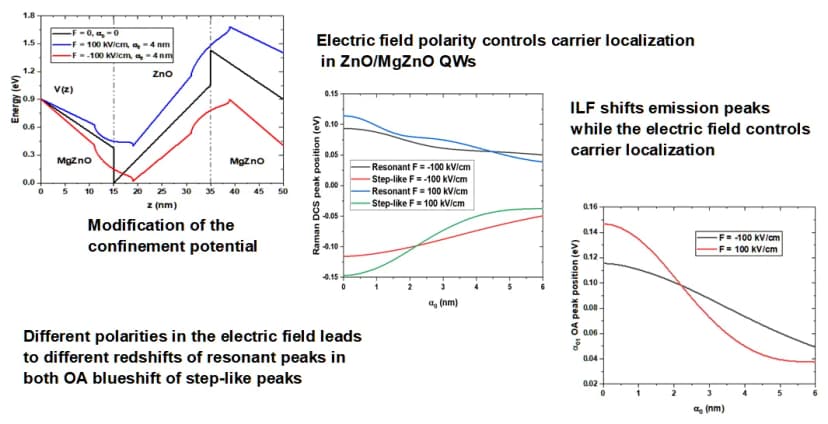
This work demonstrates that the combined action of an ILF and an external electric field constitutes a highly flexible mechanism for engineering the optical properties in polar quantum well systems. The strong sensitivity of Raman gain to small variations of the dressing parameter, together with the polarity-dependent tunability of absorption and scattering channels, opens pathways for dynamically reconfigurable optoelectronic devices. These results are particularly relevant for ZnO-based platforms, where intrinsic polarization fields add an additional degree of control absent in conventional III-V heterostructures.
The electronic structure and optical response of an asymmetric ZnO/MgZnO quantum well under the simultaneous action of a non-resonant intense laser field (ILF) and an external electric field are investigated theoretically. Using the Kramers-Henneberger formalism and the effective mass approximation, the dressed confinement potential, subband energies, dipole matrix elements, linear optical absorption, Raman differential cross section, and Raman gain are computed. The interplay between laser-induced renormalization and field-induced asymmetry produces polarity-dependent localization, pronounced absorption redshifts, non-monotonic Raman responses, and resonant gain enhancements of several orders of magnitude.
Article type: Research Article
Submitted: 25 September 2025
Revised: 3 November 2025
Accepted: 11 November 2025
First published: 5 December 2025
DOI: https://doi.org/10.69626/qa.2025.0004
Volume: Volume 1
Issue: 01
Pages: 04-18
Citation: Quantum Advances 1(1), 04-18 (2025)