


Subscribe To Get Information, Latest News And Other Interesting Events!



Important Links
Get In Touch
Ariston Publication
3167 Riverview Place
Columbus, OH 43202
United States of America
Copyright © 2026 Ariston Publications. All Rights Reserved.
Loading Your Library
Preparing your reading experience...
Loading content...
Ariston Publication
3167 Riverview Place
Columbus, OH 43202
United States of America
K. Benabdelmalek, M. Chnafi, M. Hbibi, S. Chouef, L. Belamkadem, M. El Hadi, R. Boussetta, O. El Abouti, O. Mommadi, A. El Moussaouy
K. Benabdelmalek 1
M. Chnafi2
M. Hbibi 2,*
S. Chouef 2
L. Belamkadem 2
M. El Hadi 2
R. Boussetta 1
O. El Abouti 1
O. Mommadi 3
A. El Moussaouy 2, 4
1 LRDSI, Department of Physics, Al-Hoceima Faculty of Science and Technology, Abdelmalek Essaâdi University, Tétouan, Morocco.
2 OAPM group, Laboratory of Materials, Waves, Energy and Environment, Department of Physics, Faculty of Sciences, University Mohamed I, 60000 Oujda, Morocco.
3 Research Laboratory in Sciences and Techniques, ESEFA, Ibnou Zohr University, Agadir, Morocco.
4 Laboratory of Innovation in Science, Technology and Education, Regional Centre for the Professions of Education and Training, 60000 Oujda, Morocco
* Author to whom correspondence should be addressed:
drhbibi.mohammed@gmail.com (M. Hbibi)
We present a comprehensive first-principles investigation of the structural and electronic properties of cubic NaGeBr3, a lead-free germanium-based halide perovskite with promising potential for optoelectronic applications. Calculations were performed within the framework of Density Functional Theory, employing both the Generalized Gradient Approximation (GGA-PBE) and the Local Density Approximation as implemented in the Quantum ESPRESSO simulation package. Structural optimization confirms that NaGeBr3 adopts a stable cubic perovskite phase with a GGA-derived equilibrium lattice parameter of 5.445 Å, in good agreement with previous theoretical studies. The bulk modulus of 22.9 GPa indicates a mechanically soft and flexible material, favorable for thin-film device integration. Electronic band structure calculations reveal a direct bandgap of approximately 0.34 eV at the high-symmetry R-point, confirming efficient light absorption and carrier generation potential. Analysis of the total and partial density of states shows that the valence band is predominantly composed of Br-4p orbitals, while the conduction band is mainly governed by Ge-4s and Ge-4p states, with negligible contribution from Na. The absence of mid-gap defect states further reinforces the material's quality and stability. These results establish NaGeBr3 as a highly promising, environmentally benign candidate for next-generation solar cells and light-emitting diodes.
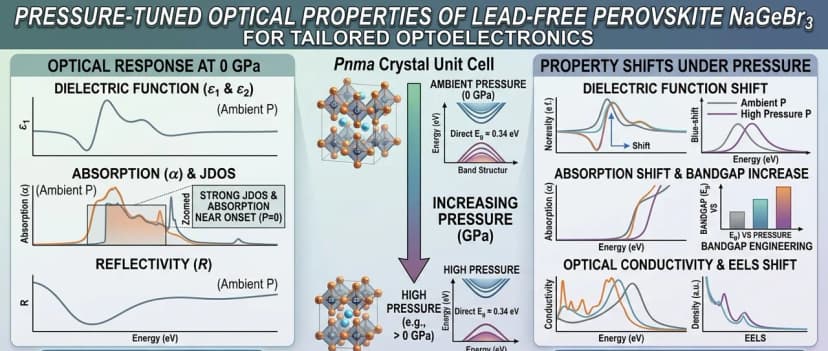
This study is significant as it identifies NaGeBr3 as a non-toxic, environmentally benign alternative to hazardous lead-based materials in solar cells and LEDs. Its direct bandgap nature ensures efficient light absorption and radiative recombination, which are critical for high-performance optoelectronics. Furthermore, its low bulk modulus of 22.9 GPa indicates mechanical flexibility, making it highly suitable for thin-film device integration. These findings provide a theoretical foundation for developing sustainable, next-generation semiconductor technologies.
This research utilizes Density Functional Theory (DFT) to investigate the structural and electronic properties of the lead-free halide perovskite NaGeBr3. Using the Quantum ESPRESSO package, the authors determined that the material adopts a stable cubic phase with an equilibrium lattice parameter of 5.445 Å. Electronic analysis reveals a direct bandgap of 0.34eV at the R-point. The study further identifies that the valence band is dominated by Br-4p orbitals, while the conduction band is governed by Ge-4s/4p states.
Article type: Research Article
Submitted: 14 October 2025
Revised: 19 November 2025
Accepted: 29 November 2025
First published: 14 December 2025
DOI: https://doi.org/10.69626/qa.2025.0049
Volume: Volume 1
Issue: 01
Pages: 49-55
Citation: Quantum Advances 1(1), 49-55 (2025)
Benabdelmalek, K., Chnafi, M., Hbibi, M., Chouef, S., Belamkadem, L., El Hadi, M., Boussetta, R., El Abouti, O., Mommadi, O. and El Moussaouy, A. 2025. Structural and Electronic Properties of NaGeBr3 Halide Perovskite. Quantum Advances 1(1), pp. 49-55; https://doi.org/10.69626/qa.2025.0049.
Number of downloads: 7
Number of views: 84