


Subscribe To Get Information, Latest News And Other Interesting Events!



Important Links
Get In Touch
Ariston Publication
3167 Riverview Place
Columbus, OH 43202
United States of America
Copyright © 2026 Ariston Publications. All Rights Reserved.
Loading Your Library
Preparing your reading experience...
Loading content...
Ariston Publication
3167 Riverview Place
Columbus, OH 43202
United States of America

Camilo Frías Viña, Fernando Guerrero Almanza, Juan Alejandro Vinasco, J. Sierra-Ortega, Gene Elizabeth Escorcia-Salas
Camilo Frías Viña1
Fernando Guerrero Almanza1
Juan Alejandro Vinasco 2,*
J. Sierra-Ortega1
Gene Elizabeth Escorcia-Salas1
1 Grupo de Investigación en Teoría de la Materia Condensada, Universidad del Magdalena, Santa Marta 470004, Colombia.
2 Departamento de Ciencias Básicas, Facultad de Ingeniería y Administración, Universidad Nacional de Colombia, Palmira 763533, Colombia.
* Author to whom correspondence should be addressed: javinascos@unal.edu.co (J. A. Vinasco)
We study the electronic properties of quantum ring systems under magnetic and intense nonresonant laser fields, considering both an ideal two-dimensional ring and a Kuroda-type double-ring structure. The laser field is modeled using constant, Gaussian, and Bessel profiles, which modify the effective confinement according to their spatial intensity distribution. In the single-ring case, the laser induces a transition from a ring-like regime, with oscillatory energy levels, to a quantum dot–like behavior with an almost linear dependence on the magnetic field. This transition depends on the laser profile. For the double-ring structure, the outer ring dominates the low-energy states, while the inner ring contributes at higher energies, leading to a combined spectral response. The laser mainly modifies the angular distribution of the electronic states without inducing transfer between rings, due to the breaking of azimuthal symmetry by the x-polarization.
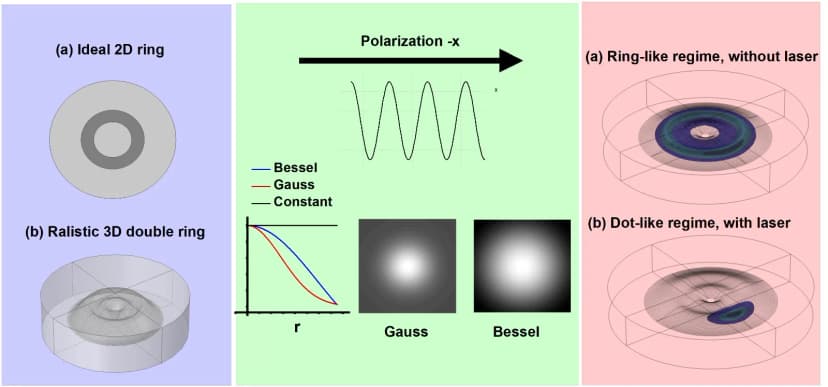
This study highlights the effect of magnetic and intense nonresonant laser fields on the electronic behavior of semiconductor quantum ring systems. By examining both single and Kuroda-type double quantum ring structures under different laser profiles, the work shows how external fields can be used to control electron confinement and modify the energy spectrum. The observed transition from ring-like behavior to quantum dot–like behavior under strong laser fields demonstrates the strong influence of optical confinement on electronic states. These results are important for the design and control of nanoscale electronic and optoelectronic devices, with possible applications in quantum computing and quantum information technologies.
This work investigates the electronic properties of single and double
quantum ring systems subjected to magnetic and intense nonresonant laser
fields. Constant, Gaussian, and Bessel laser profiles were considered to
analyze how the spatial distribution of the laser intensity modifies the
effective confinement and the electronic spectrum. The results show a
transition from ring-like to quantum dot–like behavior under laser fields. In
double-ring structures, the outer ring dominates low-energy states, while the
inner ring contributes additional features at higher energies.
Article type: Research Article
Submitted: 21 December 2025
Revised: 19 February 2026
Accepted: 6 March 2026
First published: 15 March 2026
DOI: https://doi.org/10.69626/qa.2026.0036
Volume: Volume 2
Issue: 01
Pages: 36-45
Citation: Quantum Advances 2(1), 36-45 (2026)
Viña, C. F., Almanza, F. G., Vinasco, J. A., Sierra-Ortega, J. and Escorcia-Salas, G. E. 2026. Effect of Gaussian, Bessel, and uniform laser fields on the electronic structure of single and double quantum rings under magnetic fields. Quantum Advances 2(1), pp. 36-45; https://doi.org/10.69626/qa.2026.0036.
Number of downloads: 10
Number of views: 64