


Subscribe To Get Information, Latest News And Other Interesting Events!


Important Links
Get In Touch
Ariston Publication
3167 Riverview Place
Columbus, OH 43202
United States of America
Copyright © 2026 Ariston Publications. All Rights Reserved.
Loading Your Library
Preparing your reading experience...
Loading content...
Ariston Publication
3167 Riverview Place
Columbus, OH 43202
United States of America
V. Akimov, R. Demediuk, O. Miezientseva
V. Akimov 1,*
R. Demediuk2
O. Miezientseva 2
1 Instituto de Ciencias Básicas, Universidad de Medellín, Carrera 87 No. 30–65, Medellín 050026, Colombia
2 Department of Mathematics, Physics and Computer Science, Donbas State Pedagogical University, 19 Henerala Batiuka St., Sloviansk, Donetsk Oblast 84116, Ukraine
* Author to whom correspondence should be addressed: intremun@gmail.com (V. Akimov)
In this work we investigate theorically the influence of thermal ionization of donor impurities in a δ-doped layer and a transverse electric field on the energy levels and intersubband absorption in a Si double quantum well with Si₀.₈Ge₀.₂ barriers. Charge redistribution modifies the potential profile, altering the energies and spacing of size-quantization levels and, consequently, the absorption spectra. Compared with a single quantum well, the double quantum well exhibits better-resolved absorption peaks. These results demonstrate an effective approach for tuning the optical response and frequency of silicon-based terahertz optoelectronic devices.
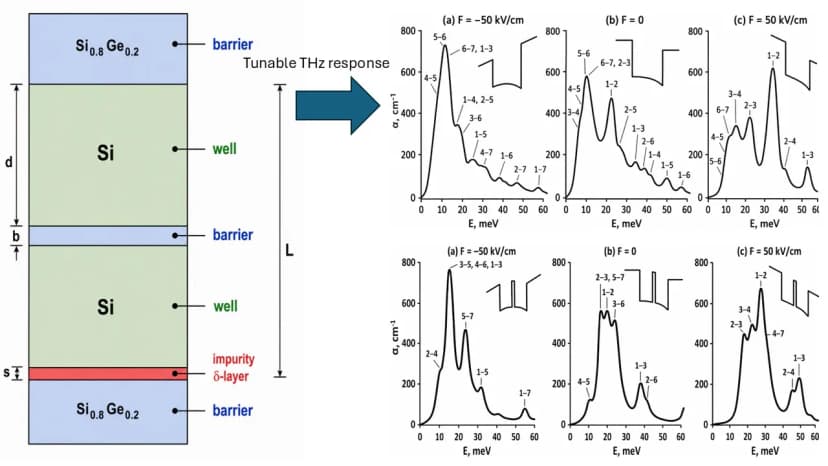
This study demonstrates that thermal ionization of donor impurities in a delta-doped layer, combined with a transverse electric field, provides effective control of the electronic structure and optical response of silicon double quantum wells. The approach enables substantial tuning of intersubband transition energies without modifying the heterostructure geometry. The resulting spectral control, together with improved absorption-peak resolution provided by the double-well configuration, offers a promising route toward dynamically tunable, silicon-based terahertz optoelectronic devices, including photodetectors, modulators, and quantum cascade emitters.
This study theoretically investigates the combined effects of donor thermal ionization and transverse electric fields on a Si/SiGe double quantum well containing a phosphorus delta-doped layer. A self-consistent Schrödinger–Poisson–electroneutrality model determines the electronic states, charge redistribution, and impurity binding energy. Increasing electronic temperature modifies the confinement potential and shifts subband energies, while the electric field provides additional control. The lowest transition changes by approximately 20 meV, corresponding to about 5 THz, and the double quantum well produces cleaner, better-resolved absorption spectra.
Article type: Research Article
Submitted: 24 April 2026
Revised: 2 May 2026
Accepted: 13 May 2026
First published: 1 June 2026
DOI: https://doi.org/10.69626/qa.2026.0046
Volume: Volume 2
Issue: 02
Pages: 46-55
Citation: Quantum Advances 2(2), 46-55 (2026)
Akimov, V., Demediuk, R. and Miezientseva, O. 2026. Combined Effects of Impurity Ionization and Transverse Electric Fields on the Electronic Structure of Double Quantum Wells. Quantum Advances 2(2), pp. 46-55; https://doi.org/10.69626/qa.2026.0046.
Number of downloads: 2
Number of views: 30