


Subscribe To Get Information, Latest News And Other Interesting Events!



Important Links
Get In Touch
Ariston Publication
3167 Riverview Place
Columbus, OH 43202
United States of America
Copyright © 2026 Ariston Publications. All Rights Reserved.
Loading Your Library
Preparing your reading experience...
Loading content...
Ariston Publication
3167 Riverview Place
Columbus, OH 43202
United States of America

M. K. Manvelyan, M. A. Mkrtchyan
M. K. Manvelyan*
M. A. Mkrtchyan
Institute of Applied Problems of Physics NAS RA, 25 Nersisyan St., Yerevan, 0014, Armenia.
* Author to whom correspondence should be addressed:
manvel.manvelyan@rau.am (M. A. Manvelyan)
This paper investigates the thermodynamic properties of an electron gas confined in a semiconductor nanoplatelet. Electrons are treated as non-interacting fermions, and the partition function of the system is calculated using the Boltzmann approximation. Using the resulting expressions for the partition function, the mean energy and entropy of the system are numerically calculated. The dependences of these thermodynamic parameters on temperature, the geometric parameters of the nanoplatelet, the number of monolayers, and the number of particles in the gas are examined. It is shown that size effects significantly influence the thermodynamic characteristics of the system, particularly at low temperatures and with small characteristic sizes of the nanoplatelet. The results obtained are of interest for describing the thermodynamic properties of electron systems in semiconductor nanostructures.
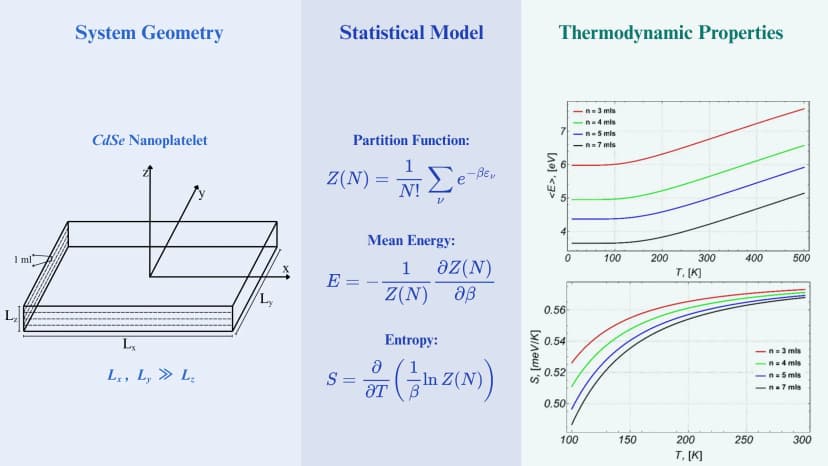
This study provides valuable insights into the thermodynamic behavior of electron gases confined within semiconductor nanoplatelets. By examining the effects of temperature, nanoplatelet geometry, monolayer count, and particle number, it highlights the importance of quantum size effects in determining the mean energy and entropy of confined electron systems. The findings are particularly significant at low temperatures and small nanoplatelet dimensions, contributing to a better understanding of nanoscale thermodynamics and supporting the theoretical design of semiconductor nanostructures for advanced electronic and quantum applications.
The study investigates the thermodynamic properties of a non-interacting electron gas confined in a semiconductor nanoplatelet. The partition function is derived using the Boltzmann approximation, and numerical calculations are performed to evaluate the mean energy and entropy. Their dependence on temperature, geometric dimensions, number of monolayers, and number of electrons is systematically examined. The results demonstrate that finite-size effects strongly influence the thermodynamic characteristics, particularly at low temperatures and for smaller nanoplatelets, emphasizing the role of confinement in nanoscale electron systems.
Article type: Research Article
Submitted: 26 April 2026
Revised: 4 May 2026
Accepted: 13 May 2026
First published: 2 June 2026
DOI: https://doi.org/10.69626/qa.2026.0056
Volume: Volume 2
Issue: 02
Pages: 56-60
Manvelyan M. K., Mkrtchyan M. A. 2026. Mean energy and entropy of the electron gas in a semiconductor nanoplatelet: the role of the number of monolayers and geometric sizes. Quantum Advances 2(2), pp. 56-60; https://doi.org/10.69626/qa.2026.0056
Number of downloads: 6
Number of views: 27