


Subscribe To Get Information, Latest News And Other Interesting Events!



Important Links
Get In Touch
Ariston Publication
3167 Riverview Place
Columbus, OH 43202
United States of America
Copyright © 2026 Ariston Publications. All Rights Reserved.
Loading Your Library
Preparing your reading experience...
Loading content...
Ariston Publication
3167 Riverview Place
Columbus, OH 43202
United States of America

A. Tiutiunnyk, U. Guevara, J. D. Correa, M. E. Mora-Ramos, I. S. Babichuk, D. Laroze
A. Tiutiunnyk1*
U. Guevara2
J. D. Correa3
M. E. Mora-Ramos4
I. S. Babichuk5,6
D. Laroze2
1 Departamento de Física, FACI, Universidad de Tarapacá, Arica, Chile.
2 Instituto de Alta Investigación, Universidad de Tarapacá, Arica, Chile.
3 Facultad de Ingenierías, Instituto de Ciencias Básicas, Universidad de Medellín, Medellín, Colombia.
4 FCentro de Investigación en Ciencias, Universidad Autónoma del Estado de Morelos, Cuernavaca, México.
5 School of Mechanical and Automation Engineering, Wuyi University, 529020 Jiangmen, P.R. China.
6 V.Ye. Lashkaryov Institute of Semiconductor Physics of the NAS of Ukraine, 03680, Kyiv, Ukraine.
* Author to whom correspondence should be addressed:
tyutyunnyk.a.m@academicos.uta.cl (A. Tiutiunnyk)
This study presents a systematic first-principles investigation into the electronic response of trilayer triangular graphene quantum dots (TGQDs) to independent interlayer rotations. The model system consists of three vertically stacked, hydrogen-passivated zigzag TGQDs (102 atoms), serving as a targeted platform to explore quantum-size effects under varying twist configurations. We perform a high-throughput density functional theory (DFT) parameter sweep over rotation angles α1, α2 ∈ [0◦, 30◦] using the vdW-DF functional to account for non-local interlayer interactions. Two distinct stacking compositions are analyzed to determine the influence of symmetry-breaking on the system's stability and electronic structure. The resulting two-dimensional maps of Fermi energy and total energy identify five anomalous angular configurations per composition. These anomalies are interpreted as a consequence of non-additive interlayer coupling that disrupts edge-state degeneracy and redistributes spin density. While the study is framed as a preliminary survey due to the restricted angular range and dot size, the results provide a quantitative basis for the "twistronic" in finite graphene nanostructures. Furthermore, the high-throughput execution across distributed workstations serves as a proof-of-concept for the necessity of automated computational workflows in mapping complex property landscapes.
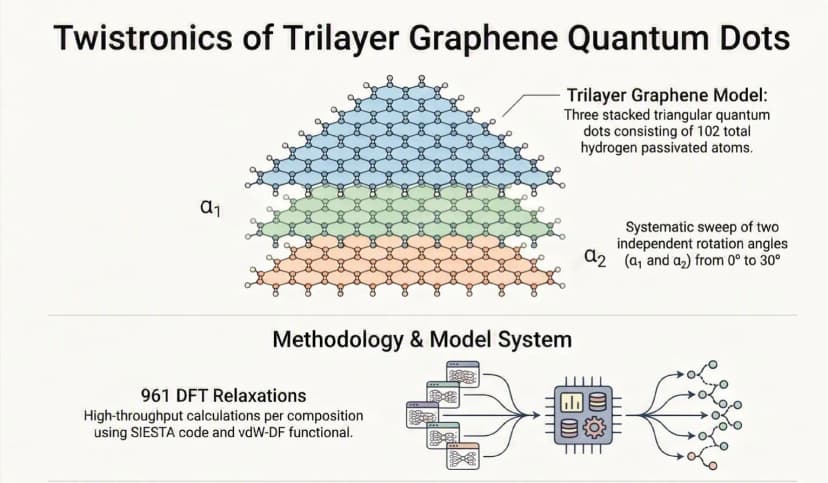
This study provides a systematic first-principles framework for understanding how independent interlayer rotations influence the electronic properties of trilayer triangular graphene quantum dots (TGQDs). By identifying anomalous configurations linked to non-additive interlayer coupling, symmetry breaking, and edge-state degeneracy, the work advances understanding of twistronics in finite graphene nanostructures. The findings offer a foundation for designing tunable nanoscale electronic systems and demonstrate the potential of automated, high-throughput density functional theory calculations for exploring complex structural and electronic property landscapes.
The study investigates the electronic response of trilayer triangular graphene quantum dots containing 102 atoms using density functional theory and the vdW-DF functional. Independent interlayer rotation angles are varied between 0° and 30° to examine their effects on Fermi energy and total energy for two stacking compositions. The resulting energy maps reveal five anomalous angular configurations for each composition, attributed to non-additive interlayer coupling, changes in edge-state degeneracy, and spin-density redistribution. The work establishes a preliminary computational basis for exploring twistronic effects in finite graphene nanostructures.
Article type: Research Article
Submitted: 29 April 2026
Revised: 8 May 2026
Accepted: 19 May 2026
First published: 3 June 2026
DOI: https://doi.org/10.69626/qa.2026.0061
Volume: Volume 2
Issue: 02
Pages: 61-68
Tiutiunnyk A., Guevara U., Correa J. D., Mora-Ramos M. E., Babichuk I. S., Laroze D. 2026. Electronic Properties of Trilayer TGQDs under Independent Interlayer Rotation: A Systematic DFT Parameter − Sweep Study. Quantum Advances 2(2), pp. 61-68; https://doi.org/10.69626/qa.2026.0061
Number of downloads: 2
Number of views: 36