


Subscribe To Get Information, Latest News And Other Interesting Events!


Important Links
Get In Touch
Ariston Publication
3167 Riverview Place
Columbus, OH 43202
United States of America
Copyright © 2026 Ariston Publications. All Rights Reserved.
Loading Your Library
Preparing your reading experience...
Loading content...
Ariston Publication
3167 Riverview Place
Columbus, OH 43202
United States of America
A. Shaer, M. K. Elsaid
A. Shaer*
M. K. Elsaid
Department of Physics, Faculty of Science, An-Najah National University, Nablus, West Bank, Palestine.
* Author to whom correspondence should be addressed:
Ayham.shaer@najah.edu (A. Shaer)
The effective Landé g-factor of an anisotropic Indium Arsenide (InAs) quantum dot (QD) is investigated under the combined influence of a magnetic field, an impurity, and Rashba (RSOI) and Dresselhaus (DSOI) spin-orbit interactions (SOI). This factor is crucial for spintronics. The results show that g is strongly tunable by the electric field (which mediates the SOI). Specifically, increasing the electric field enhances the RSOI and increases g, while DSOI tends to reduce g. In InAs, the RSOI dominates, leading to an overall enhancement of g with increasing electric field, emphasizing its potential for spin control in devices. Furthermore, g exhibits a peak value at a particular confinement strength due to a complex competition between energies. The anisotropy of the QD also provides a significant means for precisely controlling the effective g-factor.
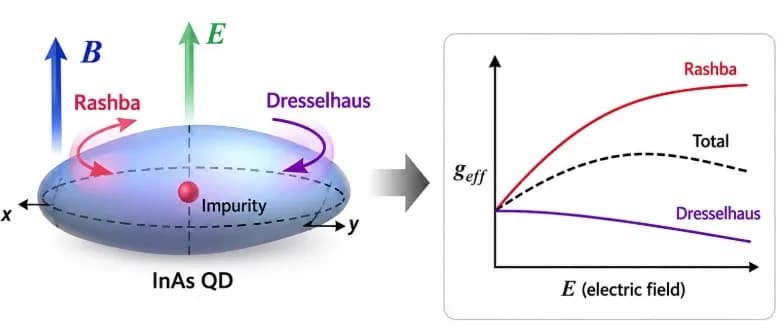
This study investigates the tunability of the effective Landé g-factor in anisotropic Indium Arsenide (InAs) quantum dots under the combined effects of magnetic fields, impurity interactions, and Rashba and Dresselhaus spin–orbit interactions. The findings highlight the dominant influence of the Rashba interaction in enhancing the g-factor with increasing electric field, while the Dresselhaus interaction tends to suppress it. The study also demonstrates the importance of quantum confinement and structural anisotropy, offering potential strategies for precise spin control in semiconductor spintronic devices.
The effective Landé g-factor of an anisotropic InAs quantum dot is examined in the presence of a magnetic field, an impurity, and Rashba and Dresselhaus spin–orbit interactions. The results indicate that the electric field modifies the spin–orbit interactions and strongly influences the \(g\)-factor. Rashba interaction dominates in InAs, producing an overall increase in the g-factor with increasing electric field, whereas Dresselhaus interaction contributes to its reduction. Additionally, the g-factor exhibits a peak at a particular confinement strength due to competing energy contributions. Quantum-dot anisotropy provides another means of controlling the effective g-factor.
Article type: Research Article
Submitted: 29 April 2026
Revised: 12 May 2026
Accepted: 25 May 2026
First published: 4 June 2026
DOI: https://doi.org/10.69626/qa.2026.0069
Volume: Volume 2
Issue: 02
Pages: 69-76
Shaer A., Elsaid M. K. 2026. The effective g factor of anisotropic InAs quantum dot under the combined effects of the applied magnetic field, impurity, and spin−orbit coupling. Quantum Advances 2(2), pp. 69-76; https://doi.org/10.69626/qa.2026.0069
Number of downloads: 2
Number of views: 21