


Subscribe To Get Information, Latest News And Other Interesting Events!



Important Links
Get In Touch
Ariston Publication
3167 Riverview Place
Columbus, OH 43202
United States of America
Copyright © 2026 Ariston Publications. All Rights Reserved.
Loading Your Library
Preparing your reading experience...
Loading content...
Ariston Publication
3167 Riverview Place
Columbus, OH 43202
United States of America
Soumyajit Beltharia, Bhaskar Bhakti, Manas Ghosh
Soumyajit Beltharia1
Bhaskar Bhakti2
Manas Ghosh1*
|
1 Department of Chemistry, Physical Chemistry Section, Visva-Bharati University, Santiniketan, Birbhum-731235, West Bengal, India. 2 Department of Chemical Sciences, Biswa Bangla Biswabidyalay, Birbhum 731204, West Bengal, India. * Author to whom correspondence should be addressed: pcmg77@gmail.com (M. Ghosh) |
The study explores the profiles of a few important nonlinear optical (NLO) properties of impurity doped GaAs quantum dot (QD). The NLO properties considered are the nonlinear optical rectification (NOR), the second harmonic generation (SHG) and the third harmonic generation (THG). The enquiry aims to understand how the interplay between Gaussian white noise and the confinement ratio (CFR) can fine-tune the above properties. The said interplay comes out to be delicately dependent on the route of incorporation of noise (additive/multiplicative) to the QD system. The interplay governs both the peak values and peak shifts of the NLO properties in rather complicated manner. Moreover, by prudent adjustment of CFR value and mode of application of noise the NLO properties can often be maximized.
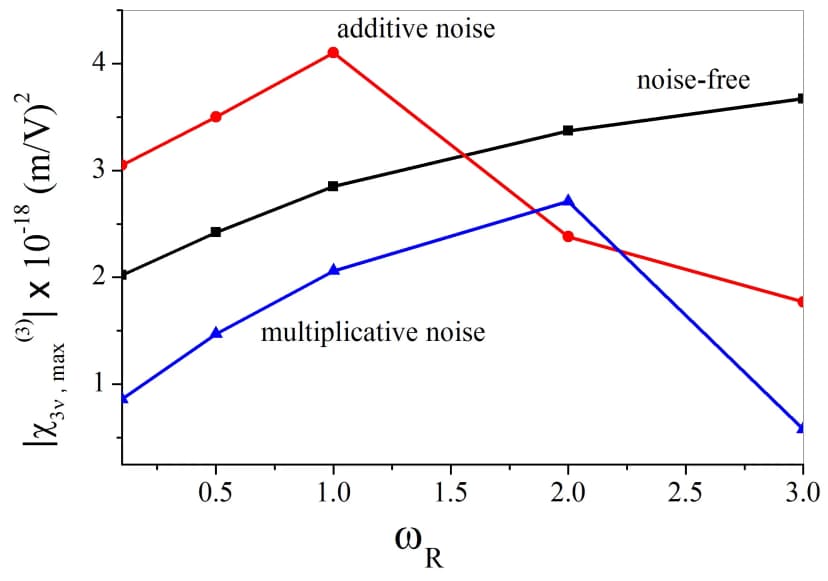
This study investigates the influence of Gaussian white noise and confinement ratio (CFR) on the nonlinear optical properties of impurity-doped gallium arsenide (GaAs) quantum dots. It focuses on nonlinear optical rectification (NOR), second-harmonic generation (SHG), and third-harmonic generation (THG), highlighting the distinct effects of additive and multiplicative noise. The findings demonstrate that the noise incorporation mechanism and confinement ratio can significantly modify peak intensities and spectral positions. These insights provide potential strategies for optimizing nonlinear optical responses in semiconductor quantum dots for optoelectronic and photonic applications.
The study examines the nonlinear optical properties of impurity-doped GaAs quantum dots, focusing on NOR, SHG, and THG under the combined influence of Gaussian white noise and confinement ratio. It investigates how additive and multiplicative noise affect the optical response. The results indicate that the interplay between noise type and confinement ratio produces complex changes in peak values and spectral shifts. Appropriate adjustment of the confinement ratio and noise incorporation method can enhance the nonlinear optical responses. The findings highlight the importance of controlling stochastic effects and quantum confinement to optimize the optical performance of semiconductor nanostructures.
Article type: Research Article
Submitted: 4 July 2026
Revised: 10 August 2026
Accepted: 30 August 2026
First published: 9 September 2026
DOI: https://doi.org/10.69626/qa.2026.0086
Volume: Volume 2
Issue: 03
Pages: 86-96