


Subscribe To Get Information, Latest News And Other Interesting Events!


Important Links
Get In Touch
Ariston Publication
3167 Riverview Place
Columbus, OH 43202
United States of America
Copyright © 2026 Ariston Publications. All Rights Reserved.
Loading Your Library
Preparing your reading experience...
Loading content...
Ariston Publication
3167 Riverview Place
Columbus, OH 43202
United States of America
Abdullah Bilekkaya
|
Abdullah Bilekkaya* |
|
|
|
Trakya University, Vocational School of Technical Sciences, Edirne-22030, Turkey *Author to whom correspondence should be addressed: abdullahbilekkaya@trakya.edu.tr (A. Bilekkaya) |
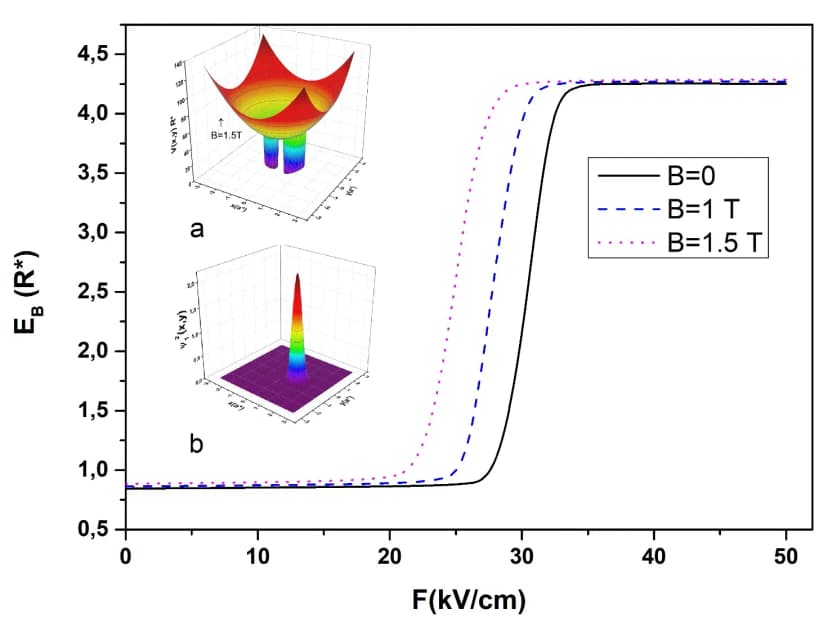
The electronic properties of asymmetric double GaAs/Al𝑥Ga1-𝑥As cylindrical quantum wires are theoretically investigated, with particular emphasis on the binding energy of a hydrogenic impurity under the combined influence of external electric and magnetic fields. Using the effective mass approximation, the single-particle Schrödinger equation is solved through a hybrid approach combining the finite difference method for the electron ground state and a variational technique for the impurity problem. The confining potential consists of two cylindrical quantum wires of different radii separated by a thin barrier, creating an asymmetric structure that allows for unique tuning of electronic states. The calculations examine various impurity positions within the structure, specifically considering impurities located at the center of either the left or right wire, while systematically varying the electric field strength up to 45 kV/cm and magnetic field intensities up to 1.5 T. The results reveal that the impurity binding energy exhibits pronounced sensitivity to all investigated parameters, displaying sharp transitions between distinct binding energy regimes as external fields modify the confinement potential. When the impurity resides in the smaller left wire, increasing electric fields cause the binding energy to undergo an abrupt step-like enhancement, attributed to field-induced transfer of the electron wavefunction from the larger to the smaller wire. Conversely, impurities positioned in the larger right wire experience a sudden decrease in binding energy under similar conditions. The magnetic field is found to shift these transition thresholds toward lower electric field values, facilitating the electron transfer process through enhanced spatial confinement. These findings provide valuable insights for the design of tunable quantum devices and may serve as a practical guide for experimental investigations of low-dimensional semiconductor structures, particularly in applications requiring controlled manipulation of impurity states through external fields.
This study investigates the binding energy of hydrogenic impurities in asymmetric double GaAs/AlₓGa₁₋ₓAs cylindrical quantum wires under the combined influence of external electric and magnetic fields. The findings reveal that impurity binding energy is highly sensitive to impurity location, structural asymmetry, and field strength. Electric-field-induced electron transfer between the wires produces sharp, step-like changes in binding energy, while magnetic fields shift the transition thresholds toward lower electric-field strengths. These insights contribute to the development of tunable semiconductor nanostructures and quantum devices with controllable impurity states.
The electronic properties of asymmetric double GaAs/AlₓGa₁₋ₓAs cylindrical quantum wires are theoretically investigated, focusing on hydrogenic impurity binding energy under external electric and magnetic fields. The effective mass approximation is employed, with the electron ground state calculated using the finite difference method and the impurity problem treated using a variational approach. The structure consists of two cylindrical wires with different radii separated by a thin barrier. The results show that binding energy depends strongly on the impurity position and field strengths. For an impurity in the smaller wire, increasing the electric field produces a sharp enhancement in binding energy, whereas an impurity in the larger wire exhibits a sudden decrease. These changes are attributed to field-induced electron transfer between the wires. Increasing the magnetic field shifts the transition thresholds toward lower electric-field values by strengthening spatial confinement.
Article type: Research Article
Submitted: 8 July 2026
Revised: 13 August 2026
Accepted: 2 September 2026
First published: 12 September 2026
DOI: https://doi.org/10.69626/qa.2026.0097
Volume: Volume 2
Issue: 03
Pages: 97-104