


Subscribe To Get Information, Latest News And Other Interesting Events!



Important Links
Get In Touch
Ariston Publication
3167 Riverview Place
Columbus, OH 43202
United States of America
Copyright © 2026 Ariston Publications. All Rights Reserved.
Loading Your Library
Preparing your reading experience...
Loading content...
Ariston Publication
3167 Riverview Place
Columbus, OH 43202
United States of America

Junior Tlotleng, Perfect Jachi, Galebonwe Ramaphane, Godiraone Adelade Nkoni, Lefika Knight Maphage, Monkami Masale, Moletlanyi Tshipa
Junior Tlotleng*
Perfect Jachi
Galebonwe Ramaphane
Godiraone Adelade Nkoni
Lefika Knight Maphage
Monkami Masale
Moletlanyi Tshipa
Department of Physics, University of Botswana, Corner of Notwane and Mobuto Road, Private Bag 0022, Gaborone, Botswana
* Author to whom correspondence should be addressed:
Tlotlengj@ub.ac.bw (J. Tlotleng)
Transition rates of an electron confined in a quantum well due to interaction with photon (electromagnetic radiation) are approximated and compared with the exact results. The energy levels of the system were calculated using the Schrödinger equation within the effective mass approximation. Wave functions of an electron confined in a quantum well are approximated, which are in turn used to approximate optical transition rates when an electron interacts with electromagnetic radiation. The approximate wave functions exhibit close agreement with the exact functions at lower quantum states but become less accurate as the principal quantum number increases. The energy eigen values of the system increase with decreasing quantum well width and the accuracy of the approximate energy eigen values decreases for higher states. Transition rates are characterized by peaks which occur whenever the energy of the incident photon equals the energy difference between states. Since the accuracy of the approximations decreases for higher energy states, the positions of the peaks corresponding to transitions involving higher states become less accurate. Increase in temperature decreases peaks of absorption transition rates while it enhances peaks of emission transition rates, a behavior captured well by the approximations.
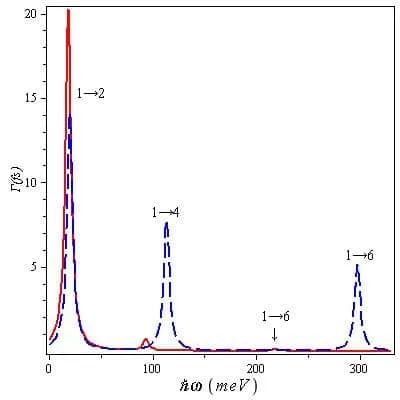
electromagnetic radiation. By comparing approximate results with exact solutions, it establishes the reliability and limitations of the approximation across different quantum states. The findings demonstrate that quantum well width and principal quantum number influence energy eigenvalues and transition-rate peak positions. The study also highlights the temperature-dependent behavior of absorption and emission, providing useful insights for modeling optical processes and designing semiconductor optoelectronic devices.
The optical transition rates of electrons confined in quantum wells under photon interaction are investigated using approximate and exact approaches. Energy eigenvalues are obtained by solving the Schrödinger equation within the effective mass approximation, and approximate wave functions are used to estimate optical transition rates. The results show that approximate wave functions agree well with exact solutions for lower quantum states but become less accurate at higher principal quantum numbers. Energy eigenvalues increase as the quantum well width decreases, while approximation errors generally increase for higher states. Transition-rate peaks occur when the incident photon energy matches the energy difference between two states, with peak positions becoming less accurate for transitions involving higher states. Increasing temperature reduces absorption-rate peaks and enhances emission-rate peaks, and these trends are captured well by the approximations.
Article type: Research Article
Submitted: 10 July 2026
Revised: 19 August 2026
Accepted: 5 September 2026
First published: 18 September 2026
DOI: https://doi.org/10.69626/qa.2026.0105
Volume: Volume 2
Issue: 03
Pages: 105-112