


Subscribe To Get Information, Latest News And Other Interesting Events!



Important Links
Get In Touch
Ariston Publication
3167 Riverview Place
Columbus, OH 43202
United States of America
Copyright © 2026 Ariston Publications. All Rights Reserved.
Loading Your Library
Preparing your reading experience...
Loading content...
Ariston Publication
3167 Riverview Place
Columbus, OH 43202
United States of America
Badriah Sultan, Mohammed S. Alqahtani, Awad Almarhaby, Khalid I. Hussein, Nehal Elkhoshkhany, Ali M. Alshehri, Manuela Reben, Fawaz Alqahtani, El Sayed Yousef
Badriah Sultan1,*
Mohammed S. Alqahtani 2,3,4
Awad Almarhaby 5
Khalid I. Hussein 2,3,6
Nehal Elkhoshkhany 7,8
Ali M. Alshehri 1
Manuela Reben 9
Fawaz Alqahtani 10
El Sayed Yousef 1,3
1 Physics Department, Faculty of Science, King Khalid University, Postcode- 9004, Zip code-61413, Abha, Saudi Arabia
2 Department of Radiological Sciences, College of Applied Medical Sciences, King Khalid University, Abha-61421, Saudi Arabia
3 Research Center for Advanced Materials Science (RCAMS), King Khalid University, Postcode- 9004, Zip code- 61413, Abha, Saudi Arabia
4 BioImaging Unit, Space Research Centre, Department of Physics and Astronomy, University of Leicester, Leicester LE1 7RH, United Kingdom
6 Department of Medical Physics and Instrumentation, National Cancer Institute, University of Gezira, Wad Medani-2667, Sudan.
7 Physics Department, College of Arts and Sciences at Tabrjal, Jouf University, Sakaka-72388, Saudi Arabia
8 Department of Material Science, Institute of Graduate Studies and Research, Alexandria University, 163 Horreya Avenue, Shatby, Alexandria 21526, Egypt
9 Faculty of Materials Science and Ceramics, AGH – University of Science and Technology, al. Mickiewicza 30, 30-059 Cracow, Poland
10 Department of Radiological Sciences, College of Applied Medical Sciences, Najran University, Najran 1988, Saudi Arabia.
* Author to whom correspondence should be addressed: bsoltan@kku.edu.sa (B. Sultan)
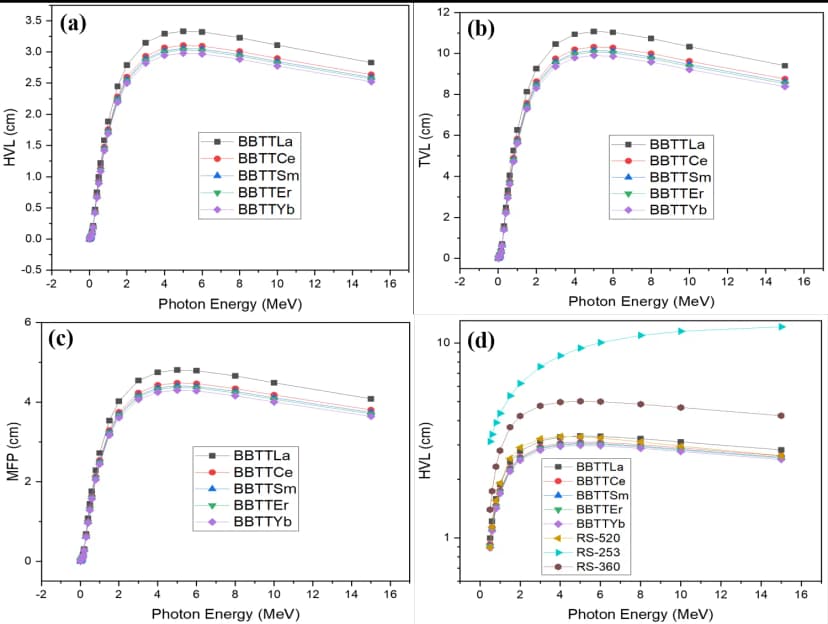
This study experimentally investigates the radiation shielding performance of novel tellurite-based glass systems doped with rare earth oxides. Glasses with composition 45TeO₂–25B₂O₃–20Bi₂O₃–7TiO₂–3RE (where RE = La₂O₃, Ce₂O₃, Sm₂O₃, Er₂O₃, and Yb₂O₃) were synthesized and characterized. The attenuation properties were evaluated using gamma-ray spectroscopy across multiple energy points (59.5 keV to 1330 keV) from Am-241, Cs-137, and Co-60 radioisotopes. Key radiation shielding parameters, including linear and mass attenuation coefficients, half-value layer, tenth-value layer, mean free path, effective atomic number, and fast neutron removal cross-section, were derived experimentally and further analyzed using the Phy-X/PSD software for a comprehensive energy range (0.015–15 MeV). Results demonstrate that all fabricated glasses exhibit substantial photon attenuation, with performance positively correlated with density. The Yb-doped glass (BBTTYb) displayed the highest density (6.31 g/cm³) and superior shielding characteristics, including the lowest half-value layer and mean free path across most energies. Enhanced attenuation is attributed to the increased effective atomic number and electron density provided by the heavy rare earth incorporation. These findings confirm that rare earth doping, particularly with Yb₂O₃, significantly improves the gamma-ray shielding capacity of tellurite glasses. The developed materials show strong potential for use in medical, industrial, and research facilities where effective radiation protection is required across a broad energy spectrum.
This research advances radiation shielding materials by developing novel rare earth-doped glasses. It demonstrates how strategic dopant selection, particularly heavy rare earths like ytterbium, can significantly enhance gamma-ray attenuation. The findings provide crucial data for designing superior, compact protective barriers essential for medical radiotherapy, nuclear facilities, and aerospace applications, offering a performance-tunable alternative to conventional shields.
The study synthesized tellurite glasses (45TeO₂–25B₂O₃–20Bi₂O₃–7TiO₂–3RE) doped with various rare earth oxides. Radiation shielding parameters were measured experimentally and via simulation. Results showed all glasses provided substantial attenuation, with performance increasing with density. Yb₂O₃-doped glass exhibited the best shielding, due to highest density and effective atomic number, confirming rare earth doping, especially with Yb, enhances gamma-ray shielding for broad-spectrum applications.
Article type: Research Article
Submitted: 15 September 2024
Revised: 29 October 2024
Accepted: 3 December 2024
First published: 13 January 2025
DOI: https://doi.org/10.69626/sag.2025.0004
Volume: Volume 1
Issue: 1
Pages: 04-15
Citation: Science of Alloys and Glasses 1(1), 04-15 (2025)
Sultan, B., Alqahtani, M. S., Almarhaby, A., Hussein, K. I., Elkhoshkhany, N., Alshehri, A. M., Reben, M., Alqahtani, F. and Yousef, E. S. 2025. Effect of Rare Earth Dopants on the Radiation Shielding Properties of Basic Oxide Glasses for High Energy Photon Applications. Science of Alloys and Glasses 1(1), pp. 04-15; https://doi.org/10.69626/sag.2025.0004.
Number of downloads: 35
Number of views: 141