


Subscribe To Get Information, Latest News And Other Interesting Events!


Important Links
Get In Touch
Ariston Publication
3167 Riverview Place
Columbus, OH 43202
United States of America
Copyright © 2026 Ariston Publications. All Rights Reserved.
Loading Your Library
Preparing your reading experience...
Loading content...
Ariston Publication
3167 Riverview Place
Columbus, OH 43202
United States of America
Zahrah S.A Almutawah, Ibrahim Hadadi, Awad Almarhaby, Ibtesam S. Asiri, Elhussaien Elshiekh, Badriah Sultan
Zahrah S.A Almutawah 1
Ibrahim Hadadi 2
Awad Almarhaby 3
Ibtesam S. Asiri 1
Elhussaien Elshiekh2
Badriah Sultan 1, *
1 Department of Physics, Faculty of Science, King Khalid University, AlQuraa, Abha, P. O. Box 906, Saudi Arabia..
2 Department of Radiological Sciences, College of Applied Medical Sciences, King Khalid University, AlQuraa, Abha, P. O. Box 906, Saudi Arabia.
3 Medical Physics Department, King Fahd General Hospital, Ministry of Health, Al Andalus, Jeddah 23325, Jeddah, Saudi Arabia.
* Author to whom correspondence should be addressed: bsoltan@kku.edu.sa(Badriah Sultan)
This research presents an experimental investigation into the radiation shielding capabilities of newly developed tellurite-based glasses incorporating rare earth oxides. The glass systems were synthesized with a base composition of 45TeO₂–25B₂O₃–20Bi₂O₃–7TiO₂–3RE, where RE represents La₂O₃, Ce₂O₃, Sm₂O₃, Er₂O₃, and Yb₂O₃. The attenuation behavior of these glasses was assessed using gamma-ray spectroscopy across a range of energies (59.5 keV to 1330 keV) derived from Am-241, Cs-137, and Co-60 radioactive sources. Fundamental shielding parameters such as linear and mass attenuation coefficients, half-value layer, tenth-value layer, mean free path, effective atomic number, and fast neutron removal cross-section were determined experimentally. These findings were further validated and extended across a broader energy spectrum (0.015–15 MeV) using the Phy-X/PSD simulation software. Results indicate that all fabricated glasses offer considerable photon attenuation, with performance directly linked to material density. The Yb-doped variant (BBTTYb) achieved the highest density of 6.31 g/cm³ and demonstrated the most effective shielding properties, including the lowest half-value layer and mean free path across the majority of energy levels. The improved attenuation is credited to the rise in effective atomic number and electron density resulting from the inclusion of heavy rare earth elements. This study confirms that doping tellurite glasses with rare earth oxides, especially Yb₂O₃, markedly enhances their gamma-ray shielding efficiency. These advanced glass systems hold significant promise for deployment in medical, industrial, and research settings that require robust radiation protection over a wide energy range.
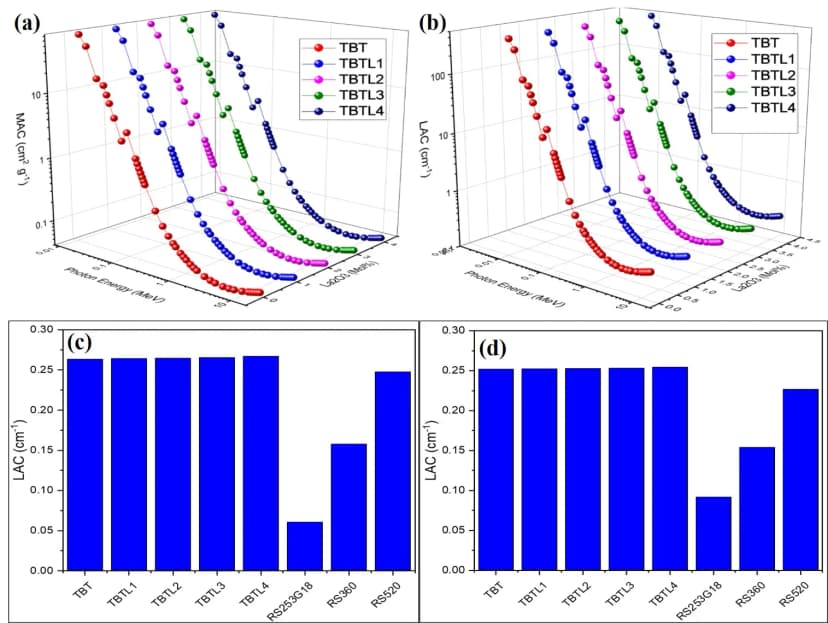
This research is significant for developing superior, lead-free radiation shielding materials. By systematically incorporating rare earth oxides into tellurite glass, it demonstrates a method to significantly enhance protection against both gamma rays and neutrons. The findings provide crucial data for designing compact, effective shields for medical, nuclear, and industrial facilities, offering a tunable and environmentally safer alternative to conventional materials like lead.
The study synthesized tellurite glasses (45TeO₂–25B₂O₃–20Bi₂O₃–7TiO₂–3RE, RE=La,Ce,Sm,Er,Yb) and evaluated their shielding performance. Parameters were measured experimentally and via Phy-X/PSD simulation. Results showed shielding effectiveness increased with density and rare earth atomic number. Yb₂O₃-doped glass achieved the highest density (6.31 g/cm³) and best attenuation, confirming rare earth doping, particularly with heavy elements like Yb, markedly improves gamma and neutron shielding.
Article type: Research Article
Submitted: 23 September 2024
Revised: 3 November 2024
Accepted: 11 December 2024
First published: 19 January 2025
DOI: https://doi.org/10.69626/sag.2025.0028
Volume: Volume 1
Issue: 1
Pages: 28-37
Citation: Science of Alloys and Glasses 1(1), 28-37 (2025)
Almutawah, Z. S.A., Hadadi, I., Almarhaby, A., Asiri, I. S., Elshiekh, E., and Sultan, B. 2025. Radiation Shielding Performance of Dense Tellurite Glasses Doped with Rare Earth Oxides against High–Energy Photons and Neutrons. Science of Alloys and Glasses 1(1), pp. 28-37; https://doi.org/10.69626/sag.2025.0028.
Number of downloads: 14
Number of views: 117