


Subscribe To Get Information, Latest News And Other Interesting Events!



Important Links
Get In Touch
Ariston Publication
3167 Riverview Place
Columbus, OH 43202
United States of America
Copyright © 2026 Ariston Publications. All Rights Reserved.
Loading Your Library
Preparing your reading experience...
Loading content...
Ariston Publication
3167 Riverview Place
Columbus, OH 43202
United States of America
Lama H. Alhayaza, Rana S. Alayyash, Hajar S. Alqahtani, Haifa H. Alqahtani, Roaa A. Asiri, Sarah M. Alshehri, Mohammad Abohassan
Lama H. Alhayaza 1
Rana S. Alayyash 1,*
Hajar S. Alqahtani 1
Haifa H. Alqahtani 1
Roaa A. Asiri 1
Sarah M. Alshehri 1
Mohammad Abohassan 2, 3
1 Department of Radiological Sciences, College of Applied Medical Sciences, King Khalid University, AlQuraa, Abha, P. O. Box 906, Saudi Arabia
2 Department of Clinical Laboratory Sciences, College of Applied Medical Sciences, King Khalid University, Abha, Saudi Arabia.
3 Health and Medical Research Centre, King Khalid University, Abha 61421, Saudi Arabia
* Author to whom correspondence should be addressed: ranasaalayash@gmail.com (Rana S. Alayyash)
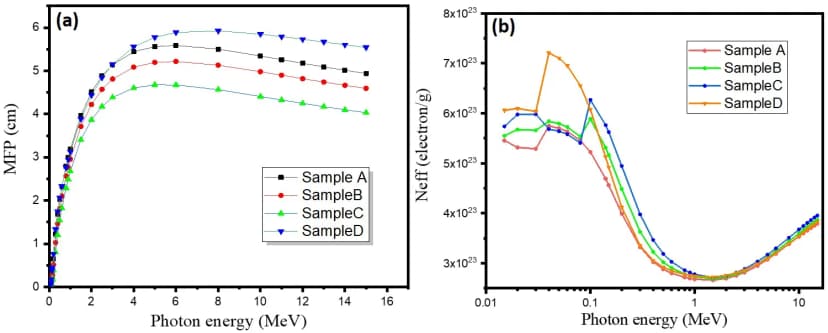
This study comprehensively examines the radiation shielding capabilities and in vitro biological properties of tellurite-based glasses modified with various heavy metal oxides. A series of glasses with the nominal composition (85-x)TeO₂–5Nb₂O₅–xZnO, incorporating distinct modifiers (5Ag₂O, 7PbO, 18PbO, and 7Na₂O in mol%), were investigated. The photon attenuation characteristics were evaluated computationally using MIKE simulation software across a broad energy spectrum (0.015–15 MeV). Key shielding parameters, including mass and linear attenuation coefficients (MAC, LAC), half-value layer (HVL), mean free path (MFP), and effective atomic number (Zeff), were determined. Results indicate a direct correlation between shielding performance and material density, with the 18 mol% PbO-doped glass exhibiting the most promising attenuation properties. This sample achieved the highest MAC and Zeff values, along with the lowest HVL and MFP, confirming superior gamma-ray shielding efficacy. Furthermore, the in vitro biological activity of the glass compositions was assessed. Antibacterial susceptibility tests revealed significant activity against Gram-positive bacteria, including Staphylococcus aureus and Streptococcus pyogenes, while effects on Gram-negative strains were minimal. Additionally, blood coagulation assays (PT and APTT) demonstrated that certain compositions could modulate clotting times, suggesting potential hemostatic applications. This dual functionality positions these modified tellurite glasses as promising candidates for advanced materials in both radiation protection and biomedical fields.
This research is significant for pioneering multifunctional tellurite glasses that merge effective radiation shielding with beneficial biological properties. By demonstrating both high gamma-ray attenuation from heavy metal oxides and in vitro antibacterial/hemostatic activity, it opens pathways for novel materials. Such dual-purpose glasses could revolutionize protective equipment in medical settings, serving simultaneously as radiation barriers and bioactive surfaces for infection control or wound care, moving beyond single-function materials.
The study computationally and experimentally evaluated (85-x)TeO₂–5Nb₂O₅–xZnO glasses modified with Ag₂O, PbO, or Na₂O. Simulations across 0.015–15 MeV showed 18 mol% PbO-doped glass had the best shielding (highest Zeff, lowest HVL). In vitro tests revealed selective antibacterial activity against Gram-positive bacteria and, notably, that certain compositions significantly reduced blood clotting times (PT, APTT). This confirms the glasses' dual functionality for radiation protection and potential hemostatic biomedical applications.
Article type: Research Article
Submitted: 19 October 2024
Revised: 25 November 2024
Accepted: 2 January 2025
First published: 4 February 2025
DOI: https://doi.org/10.69626/sag.2025.0038
Volume: Volume 1
Issue: 1
Pages: 38-50
Citation: Science of Alloys and Glasses 1(1), 38-50 (2025)
Alhayaza, L. H., Alayyash, R. S., Alqahtani, H. S., Alqahtani, H. H., Asiri, R. A., Alshehri, S. M., and Abohassan, M. 2025. Investigating Radiation Shielding Efficiency and In–Vitro Biological Performance of Modified Tellurite Glasses. Science of Alloys and Glasses 1(1), pp. 38-50; https://doi.org/10.69626/sag.2025.0038.
Number of downloads: 61
Number of views: 103