


Subscribe To Get Information, Latest News And Other Interesting Events!


Important Links
Get In Touch
Ariston Publication
3167 Riverview Place
Columbus, OH 43202
United States of America
Copyright © 2026 Ariston Publications. All Rights Reserved.
Loading Your Library
Preparing your reading experience...
Loading content...
Ariston Publication
3167 Riverview Place
Columbus, OH 43202
United States of America
Al-Anoud T. Al Ahmari, Bayan Aljuwaybiri
Al-Anoud T. Al Ahmari 1
Bayan Aljuwaybiri 2,*
1 Department of Physics, Faculty of Science, King Khalid University, AlQuraa, Abha, P. O. Box 906, Kingdom of Saudi Arabia.
2 De Armed Forces hospitals-Taif Region Taif, Kingdom of Saudi Arabia.
* Author to whom correspondence should be addressed: Bayanomar275@gmail.com(B. Aljuwaybiri)
A series of erbium oxide (Er₂O₃)-doped tellurite heavy metal oxide glasses with the composition 62TeO₂–5K₂TeO₃–20ZnO–10Nb₂O₅–3PbF₂–xEr₂O₃ (x = 2, 3, and 4.5 mol%) were developed and examined to assess their suitability for radiation shielding applications. The gamma-ray attenuation performance was analyzed across a wide photon energy range using essential shielding parameters such as the linear attenuation coefficient (LAC), mass attenuation coefficient (MAC), half-value layer (HVL), tenth-value layer (TVL), mean free path (MFP), and effective atomic number (Zeff). The findings indicate that incorporating Er₂O₃ improves the glass system's radiation attenuation. This improvement is associated with increases in density and atomic number, which enhance the probability of photon interaction. As a result, higher attenuation coefficients and lower penetration-related parameters were observed, confirming the effectiveness of erbium incorporation in strengthening the shielding performance. The prepared glasses showed particularly strong attenuation behavior within photon energy ranges relevant to diagnostic imaging. These results demonstrate that Er₂O₃-doped tellurite glasses offer a promising combination of radiation-shielding efficiency, making them suitable candidates for medical radiation protection applications.
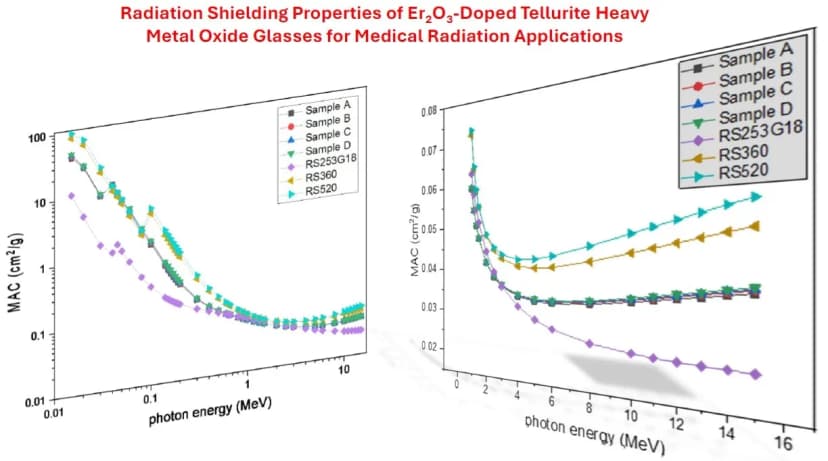
This study systematically demonstrates that Er₂O₃ doping significantly enhances the gamma-ray shielding performance of tellurite heavy metal oxide glasses for medical radiation applications. By increasing erbium content from 2 to 4.5 mol%, density and effective atomic number rise, leading to higher attenuation coefficients and reduced penetration parameters (HVL, TVL, MFP). These glasses offer a promising alternative to conventional shielding materials, especially for diagnostic X-ray protection.
A tellurite glass system (62TeO₂–5K₂TeO₃–20ZnO–10Nb₂O₅–3PbF₂) doped with 2–4.5 mol% Er₂O₃ was prepared and evaluated for radiation shielding. Key parameters—LAC, MAC, HVL, TVL, MFP, and Zeff—were analyzed across a wide photon energy range. Results showed that higher Er₂O₃ content improved attenuation performance, particularly at low energies relevant to medical diagnostics, confirming the glasses' suitability for radiation protection.
Article type: Research Article
Submitted: 18 January 2025
Revised: 29 March 2025
Accepted: 3 June 2025
First published: 17 June 2025
DOI: https://doi.org/10.69626/sag.2025.0135
Volume: Volume 1
Issue: 3
Pages: 135-141
Citation: Science of Alloys and Glasses 1(3), 135-141 (2025)
Al-Ahmari, A. T. and Aljuwaybiri, B. 2025. Radiation Shielding Properties of Er2O3–Doped Tellurite Heavy Metal Oxide Glasses for Medical Radiation Applications. Science of Alloys and Glasses 1(3), pp. 135-141; https://doi.org/10.69626/sag.2025.0135.
Number of downloads: 3
Number of views: 49