


Subscribe To Get Information, Latest News And Other Interesting Events!


Important Links
Get In Touch
Ariston Publication
3167 Riverview Place
Columbus, OH 43202
United States of America
Copyright © 2026 Ariston Publications. All Rights Reserved.
Loading Your Library
Preparing your reading experience...
Loading content...
Ariston Publication
3167 Riverview Place
Columbus, OH 43202
United States of America
Usman Sani, U. Ibrahim, A. A. Mundi, M. M. Idris, Rabiatu Mahadi, U. M. Kankara
Usman Sani 1, 2,*
U. Ibrahim 2
A. A. Mundi 2
M. M. Idris 2
Rabiatu Mahadi 1
U. M. Kankara 3
1 Department of Physics Umaru Musa Yar’adua University, Katsina-Nigeria.
2 Department of Physics Nasarawa State University, Keffi-Nigeria.
3 Department of Physics Ahmadu Bello University, Zaria-Nigeria
* Author to whom correspondence should be addressed:
usnansani77@gmail.com (Usman Sani)
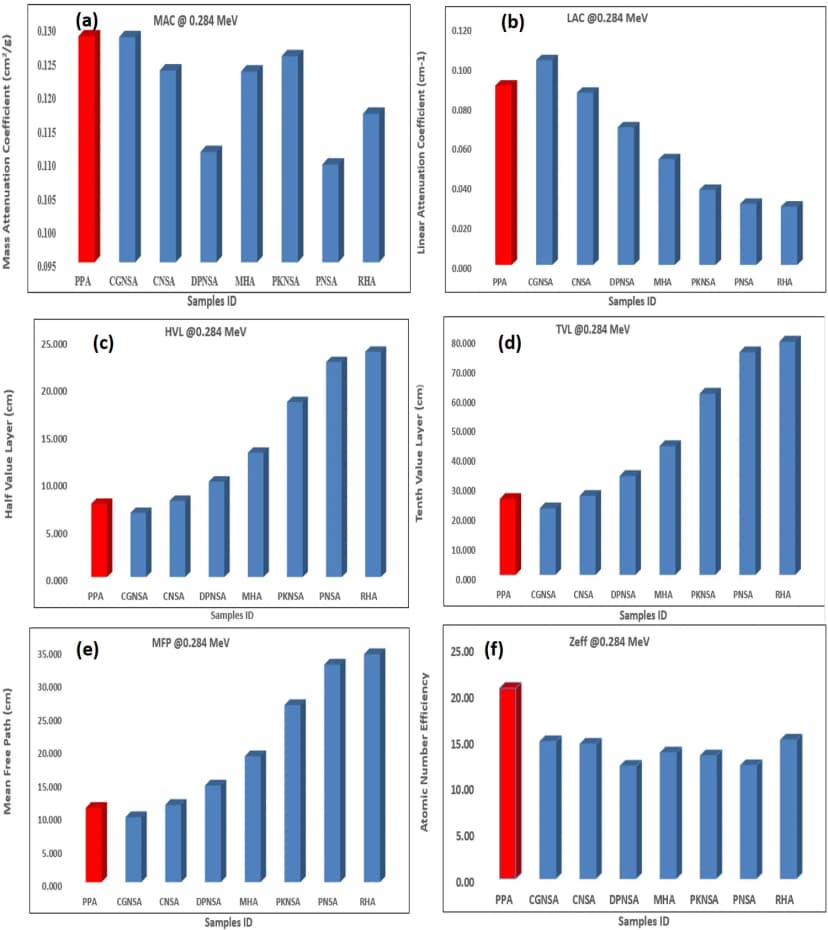
This study aims at assessing the recycling and ethical considerations of Parkia Pods Ash (PPA) composites as a non-toxic alternative for sustainable gamma radiation shielding applications. The sample was heated and converted to ash at 400 °C for 2 hours using a muffle furnace. The sample was characterized using EDXRF, XRD, and TGA/DTA analyses, and the attenuation parameters were simulated using PHY-X software. The EDXRF confirmed the total elements present in the sample, which include Bi, W, K, Si, Fe, Ca, Sn, P, and Cl, while the XRD analysis confirmed the crystalline structure of the sample ranging from 29-55° at 2θ. The sample demonstrates slow decomposition starting at 295 °C. The sample dehydrated at 520 °C and carbonized at 900 °C with a residue of 19%, confirming the high temperature resistance and thermal stability of the PPA. The PHY-X simulation results showed a significant improvement in the shielding profile of the ash sample. The Mass Attenuation Coefficient (MAC) and Linear Attenuation Coefficient (LAC) significantly decreased from 0.128 to 0.028 cm²/g and 0.090 to 0.020 cm⁻¹ at energy levels of 0.284 MeV to 15.00 MeV, for MAC and LAC, respectively. This indicates transitions in the gamma interaction region from photoelectric effect to Compton scattering. In addition, low-energy attenuation was recorded to be high, as indicated by the decrease in HVL from 35.26 cm to 7.71 cm, TVL from 117.15 cm to 25.61 cm, and MFP from 50.88 cm to 11.12 cm. The sample demonstrated a high Z efficiency of 20.49 at the photoelectric effect region and 19.71 at the Compton scattering region. The effective atomic number (Zeff) ranged approximately from 23 to 48. A low transmission factor of 0.90 at 0.284 MeV and 1.00 cm thickness was recorded. Additionally, the sample demonstrated superior radiation protection efficiency. The findings signify that the PPA sample demonstrates high shielding capability in terms of crystallinity, high temperature resistance, thermal stability, and efficient MAC, LAC, and Zeff, as well as low attenuation. Therefore, PPA can be utilized as a non-toxic alternative and an excellent additive to be incorporated in glasses, concretes, alloys, and tungsten for effective gamma shielding applications.
This study establishes Parkia Pods Ash as a sustainable, non-toxic alternative for gamma radiation shielding, addressing the environmental and health hazards associated with lead and conventional concrete. By valorizing agricultural waste, the research promotes circular economy principles while providing effective radiation protection. The presence of high-Z elements (Bi, W, Fe) in the ash demonstrates superior attenuation properties, offering a cost-effective and locally available solution for shielding applications in nuclear medicine, industry, and research facilities across developing regions.
Parkia Pods Ash was characterized using EDXRF, XRD, and TGA/DTA analyses, revealing high-Z elements (Bi, W, K, Si, Fe) and crystalline structure with excellent thermal stability up to 900°C. PHY-X simulation evaluated attenuation parameters from 0.284-15.00 MeV, demonstrating high MAC, LAC, and Zeff with low HVL, TVL, and MFP. Comparative analysis showed PPA outperformed most biomass ashes, exhibiting low transmission factor (0.92) and high radiation protection efficiency (0.92), establishing it as an effective, sustainable shielding additive for glasses, concretes, and alloys.
Article type: Research Article
Submitted: 12 June 2025
Revised: 14 August 2025
Accepted: 11 September 2025
First published: 3 October 2025
DOI: https://doi.org/10.69626/sag.2025.0191
Volume: Volume 1
Issue: 4
Pages: 191-206
Citation: Science of Alloys and Glasses 1(4), 191-206 (2025)
Usman Sani, U., Ibrahim, U., Mundi, A. A., Idris, M. M., Mahadi, R. and Kankara, U. M. 2025. Recycling Assessment and Ethical Considerations of Parkia Pods Ash (PPA) Composites as a Non–Toxic Alternative for Sustainable Gamma Radiation Shielding Applications. Science of Alloys and Glasses 1(4), pp. 191-206; https://doi.org/10.69626/sag.2025.0191.
Number of downloads: 3
Number of views: 73