


Subscribe To Get Information, Latest News And Other Interesting Events!


Important Links
Get In Touch
Ariston Publication
3167 Riverview Place
Columbus, OH 43202
United States of America
Copyright © 2026 Ariston Publications. All Rights Reserved.
Loading Your Library
Preparing your reading experience...
Loading content...
Ariston Publication
3167 Riverview Place
Columbus, OH 43202
United States of America
A. Ibrahim, Ali M. Alshehri, Abdulaziz A. Asiri
A. Ibrahim
Ali M. Alshehri
Abdulaziz A. Asiri *
Physics Department, Faculty of Science, King Khalid University, AlQura,a, Abha, P. O. Box 906, Saudi Arabia.
* Author to whom correspondence should be addressed:
abdulaziz213a@kku.edu.edu(Abdulaziz A. Asiri)
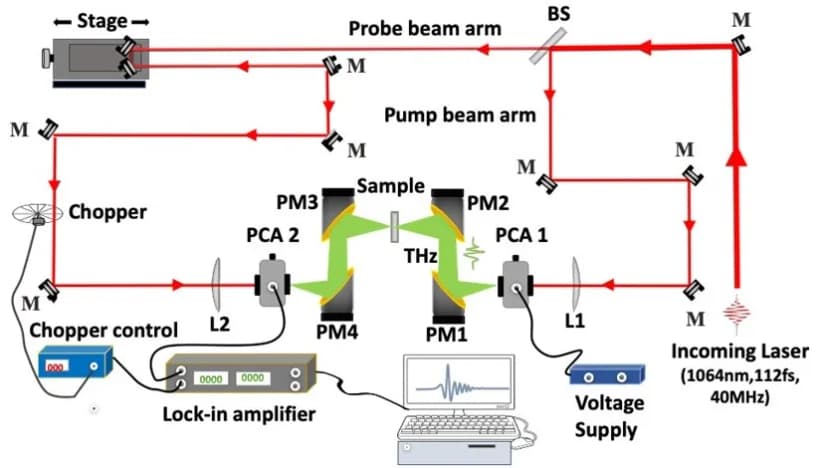
BK7 is a widely available borosilicate glass composition (74.3SiO₂-9.5B₂O₃-9.2Na₂O-5.8K₂O-1.2BaO) commonly employed as an amorphous substrate material in various laboratory environments. This study investigates the terahertz (THz) frequency properties of a standard BK7 glass substrate using a purpose-built THz time-domain spectroscopy (THz-TDS) system. The complex refractive index ñ = n + ik, absorption coefficient α, and complex dielectric constant ε̃ = ε₁ + iε₂ were extracted from experimentally obtained THz transmission data using Teralyzer software. The BK7 sample (dimensions: 7.5 cm × 2.5 cm × 1 mm) exhibited a real refractive index of n = 2.549 ± 0.002 across the 0.25-1.2 THz range, with minimal dispersion. The absorption coefficient demonstrated a monotonic increase from approximately 9.4 cm⁻¹ at 0.25 THz to 149 cm⁻¹ at 1.4 THz. The reliable spectral bandwidth of BK7 was established as 0.25-1.2 THz, beyond which strong absorption renders measurements unreliable. The real part of the complex permittivity ε₁ remained nearly constant at approximately 6.5 within the trusted bandwidth, while ε₂ exhibited small positive values increasing with frequency. These results demonstrate that although BK7 is a convenient substrate material, its strong THz absorption above 1.2 THz significantly limits its applicability for broadband THz spectroscopic measurements, establishing critical constraints for experimental design.
This research establishes benchmark THz optical constants for BK7 glass, a ubiquitous substrate material in photonics laboratories. The comprehensive characterization across 0.25–4 THz identifies the critical spectral bandwidth limitation imposed by strong absorption above 1.2 THz, providing essential guidance for experimental design. The reported refractive index (n = 2.549 ± 0.002) and dielectric constants serve as reliable reference values for accurate data interpretation in THz spectroscopy, enabling researchers to correct substrate-induced artifacts and make informed material selection decisions for broadband THz applications.
THz time-domain spectroscopy was employed to characterize the optical and dielectric properties of BK7 borosilicate glass over 0.25–4 THz. The complex refractive index, absorption coefficient, and complex permittivity were extracted from transmission measurements. The real refractive index remained constant at n = 2.549 ± 0.002 within the trusted bandwidth of 0.25–1.2 THz, while absorption increased dramatically beyond this range. The dielectric response showed ε₁ ≈ 6.5 and small ε₂ values, confirming BK7's limited suitability for broadband THz applications above 1.2 THz.
Article type: Research Article
Submitted: 9 July 2025
Revised: 25 August 2025
Accepted: 28 September 2025
First published: 17 October 2025
DOI: https://doi.org/10.69626/sag.2025.0207
Volume: Volume 1
Issue: 4
Pages: 207-214
Citation: Science of Alloys and Glasses 1(4), 207-214 (2025)
Ibrahim, A., Alshehri, A. M. and Asiri, A. A. 2025. Terahertz Optical and Dielectric Properties of BK7 Silicate Glass: Characterization of the Complex Refractive Index and Dielectric Response in the Terahertz Frequency Region. Science of Alloys and Glasses 1(4), pp. 207-214; https://doi.org/10.69626/sag.2025.0207.
Number of downloads: 12
Number of views: 128