


Subscribe To Get Information, Latest News And Other Interesting Events!



Important Links
Get In Touch
Ariston Publication
3167 Riverview Place
Columbus, OH 43202
United States of America
Copyright © 2026 Ariston Publications. All Rights Reserved.
Loading Your Library
Preparing your reading experience...
Loading content...
Ariston Publication
3167 Riverview Place
Columbus, OH 43202
United States of America

Vikash Mourya, Sapana Yadav, D. K. Dwivedi, Pooja Lohia
Vikash Mourya1
Sapana Yadav1
D.K. Dwivedi1
Pooja Lohia2
1Photonics and Photovoltaic Research Lab (PPRL), Department of Physics and Material Science, Madan Mohan Malaviya University of Technology, Gorakhpur-273010, India
2Department of Electronics and Communication Engineering, Madan Mohan Malaviya University of Technology, Gorakhpur-273010, India.
* Author to whom correspondence should be addressed: todkdwivedi@gmail.com (D. K. Dwivedi)
A twin-core photonic crystal fiber (TC-PCF) sensor is proposed featuring a rectangular analyte channel, designed for blood component detection. The cladding area of this sensor incorporates rectangular air-holes, with silica serving as the substrate material. Operating within a wavelength range of 2 µm to 3 µm. The sensor's modeling and simulation is conducted by using COMSOL Multiphysics software, while schematic curves were plotted using Origin software. This TC-PCF sensor demonstrates remarkable sensitivity, reaching 1641.2 nm/RIU for white blood cells and 2732.638 nm/RIU for red blood cells. Offering a compact and advanced solution, this sensor addresses challenges commonly encountered with traditional blood biomolecule sensors. Its cost-effectiveness and ease of fabrication may lead the proposed sensor structure for promising future applications.
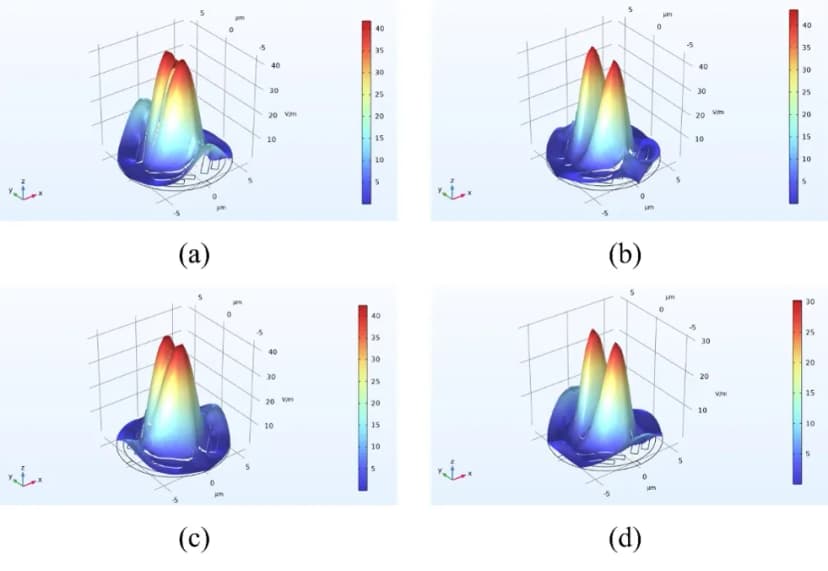
This study presents the design and evaluation of a twin-core photonic crystal fiber (TC-PCF) sensor with a rectangular analyte channel for detecting blood biomolecules. Using silica as the substrate and rectangular air-holes in the cladding, the sensor operates in the 2 µm to 3 µm wavelength range. Simulations results show high sensitivity, achieving 1641.2 nm/RIU for white blood cells and 2732.638 nm/RIU for red blood cells. This cost-effective and easy-to-fabricate sensor offers a compact solution for blood biomolecule detection.
Article type: Research Article
Submitted: 3 January 2024
Revised: 15 February 2024
Accepted: 5 March 2024
First published: 21 March 2024
DOI: https://doi.org/10.69626/sea.2024.0020
Volume: 1
Issue: 1
Pages: 20-29
Citation: SciEngg Advances 1(1), 20-29 (2024)