


Subscribe To Get Information, Latest News And Other Interesting Events!



Important Links
Get In Touch
Ariston Publication
3167 Riverview Place
Columbus, OH 43202
United States of America
Copyright © 2026 Ariston Publications. All Rights Reserved.
Loading Your Library
Preparing your reading experience...
Loading content...
Ariston Publication
3167 Riverview Place
Columbus, OH 43202
United States of America
Narendra Prasad Tripathi, Brijesh K. Pandey, Abhay P. Srivastava
Narendra Prasad Tripathi 1
Brijesh K. Pandey 2,*
Abhay P. Srivastava2
1 Department of Chemistry, R. R. Institute of Modern Technology, Lucknow, Uttar Pradesh, India
2 Department of Physics and Materials Science, Madan Mohan Malviya University of Technology, Gorakhpur, Uttar Pradesh, India
* Author to whom correspondence should be addressed: bkppms@mmmut.ac.in (B. K. Pandey)
This study investigates the ternary mixture of sodium dodecyl sulphate (SDDS) with urea in water through ultrasonic and thermodynamic analyses at temperatures of 303, 308, 313, 318, and 323 K. Experimental values were used to calculate derived parameters such as ultrasonic velocity (U), density (ρ), and viscosity (η). These parameters enabled the computation of acoustic properties, including adiabatic compressibility (βs) and intermolecular free length (Lf). The findings indicate that urea exhibits hydrophilic (structure-breaking, SB) behavior with weak interactions at lower temperatures (303-308 K) and hydrophobic (structure-making, SM) behavior with stronger interactions at higher temperatures (313-323 K). The study demonstrates that ultrasonic velocimetry is a powerful and precise method for characterizing interactions between surfactants and biomolecules. The temperature coefficients of ultrasonic velocity (∂U/∂T) and adiabatic compressibility (∂βs/∂T) were found to have positive and negative values, respectively, further confirming the temperature-dependent interaction behavior of urea. Additionally, relaxation time analysis revealed that the maximum relaxation time for the binary solution occurs at 312 K and the minimum at 323 K, whereas for the ternary solution, the maximum relaxation time is also at 312 K and the minimum at 320 K. These results have significant implications in fields such as solution chemistry, biochemistry, biosciences, surface science, surfactant chemistry, industrial chemistry, and both physical and chemical sciences.
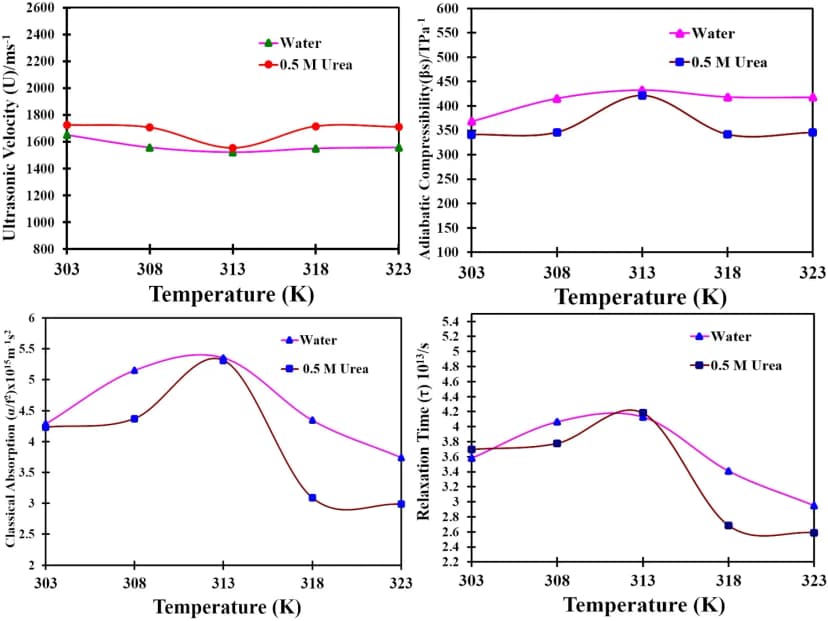
The study uses ultrasonic velocimetry to investigate the SDDS-urea-water ternary mixture at temperatures from 303 K to 323 K. Key parameters like ultrasonic velocity, density, and viscosity were measured to compute acoustic properties, indicating urea's hydrophilic behavior at lower temperatures and hydrophobic behavior at higher temperatures. Temperature coefficients of ultrasonic velocity and adiabatic compressibility confirmed the temperature-dependent interaction behavior. Relaxation time analysis showed varying interaction dynamics across temperatures, with significant implications for solution chemistry, biochemistry, and surfactant chemistry.
Article type: Research Article
Submitted: 18 February 2024
Revised: 29 March 2024
Accepted: 15 May 2024
First published: 26 May 2024
DOI: https://doi.org/10.69626/sea.2024.0074
Volume: 1
Issue: 2
Pages: 74-80
Citation: SciEngg Advances 1(2), 74-80 (2024)
Tripathi, N. P., Pandey, B. K. and Srivastava, A. P. 2024. Ultrasonic and Thermodynamic Analysis of Molecular Interaction in Sodium Dodecyl Sulphate-Urea-Water Ternary Mixtures at Various Temperatures. SciEngg Advances 1(2), pp. 74-80; https://doi.org/10.69626/sea.2024.0074
Number of downloads: 1
Number of views: 36