


Subscribe To Get Information, Latest News And Other Interesting Events!



Important Links
Get In Touch
Ariston Publication
3167 Riverview Place
Columbus, OH 43202
United States of America
Copyright © 2026 Ariston Publications. All Rights Reserved.
Loading Your Library
Preparing your reading experience...
Loading content...
Ariston Publication
3167 Riverview Place
Columbus, OH 43202
United States of America
Tanaji S. Patil, Raviraj S. Kamble, Satish A. Gangawane
1Department of Physics, Bhogawati Mahavidyalaya Kurukali, Shivaji University Kolhapur 4160012, India.
2Department of Chemistry, Bhogawati Mahavidyalaya Kurukali, Shivaji University Kolhapur 416001, India.
3Department of Physics, Doodhsakhar Mahavidyalaya Bidri, Shivaji University Kolhapur 416001, India.
*Author to whom correspondence should be addressed: gangawane.satish98@gmail.com(S. A. Gangawane); tanajipatil11@gmail.com (T. S. Patil)
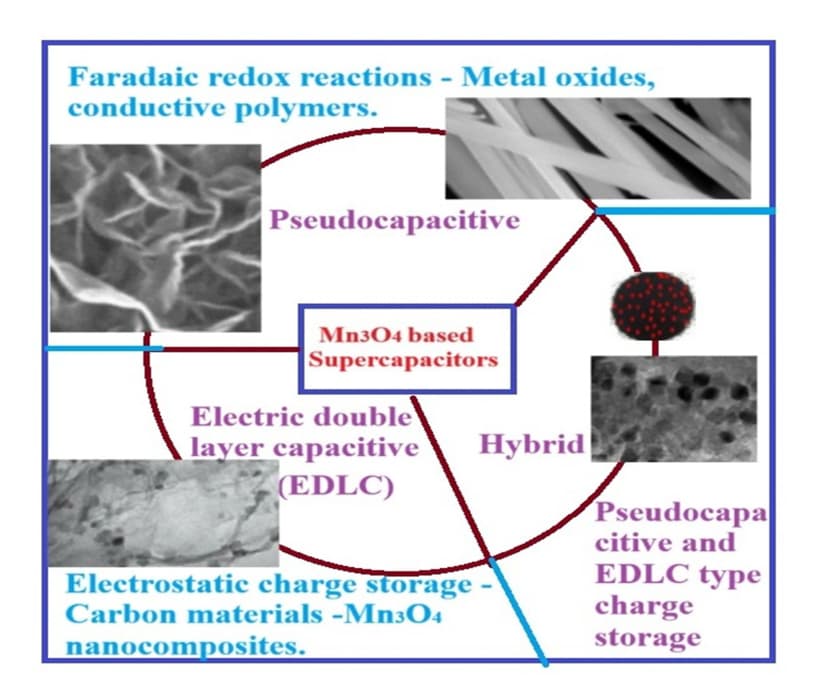
This review provides valuable insights into the potential of Mn₃O₄ nanomaterials for supercapacitor applications, addressing their advantages and limitations. By analyzing recent advancements in doping, composite formation, and ion intercalation, the study highlights strategies to enhance Mn₃O₄’s conductivity and capacitance. The findings contribute to the ongoing development of cost-effective, high-performance electrode materials, paving the way for improved energy storage technologies. This research is crucial for advancing sustainable energy solutions, particularly in portable electronics and grid storage applications.
This review explores Mn₃O₄ nanomaterials as electrode materials for supercapacitors, emphasizing their pseudocapacitive behavior and structural advantages. Despite their high theoretical capacitance, low electrical conductivity limits their performance. Strategies such as doping with transition metals, forming composites with graphene, and intercalating alkali metal ions have been examined to enhance charge storage efficiency. The study underscores the potential of Mn₃O₄-based supercapacitors in next-generation energy storage, while highlighting the need for further research to optimize their electrochemical performance and long-term stability.
Article type: Review
Submitted: 23 July 2024
Revised: 15 September 2024
Accepted: 13 November 2024
First published: 3 December 2024
DOI: https://doi.org/10.69626/sea.2025.0001
Volume: 2
Issue: 1
Pages: 01-15
Citation: SciEngg Advances 2(1), 01-15 (2025)