


Subscribe To Get Information, Latest News And Other Interesting Events!



Important Links
Get In Touch
Ariston Publication
3167 Riverview Place
Columbus, OH 43202
United States of America
Copyright © 2026 Ariston Publications. All Rights Reserved.
Loading Your Library
Preparing your reading experience...
Loading content...
Ariston Publication
3167 Riverview Place
Columbus, OH 43202
United States of America
Madhura Subramanian, Neeraja Chidambaram, Venkatachalam Rajarajan Balaji
Madhura Subramanian*
Neeraja Chidambaram*
Venkatachalam Rajarajan Balaji*
Department of Electronics and Communication Engineering, St. Joseph’s Institute of Technology, OMR, Chennai-600119, India.
*Author to whom correspondence should be addressed:
madhu97ns@gmail.com (M. Subramanian)
neerajachidambaram30@gmail.com (N. Chidambaram)
balajivr@stjosephstechnology.ac.in (V. R. Balaji)
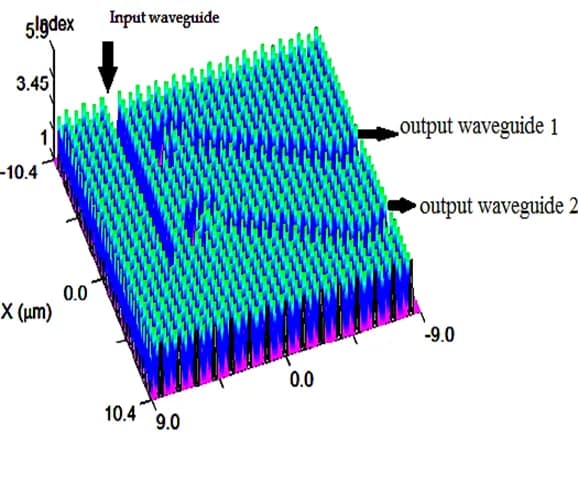
The exponential growth in data traffic driven by internet-based services necessitates the development of high-performance optical communication systems. Dense Wavelength Division Multiplexing plays a pivotal role in meeting this demand by enabling the simultaneous transmission of multiple wavelengths over a single optical fiber. This work presents the design and simulation of a two-channel DWDM demultiplexer, engineered using a two-dimensional photonic crystal with a triangular lattice of silicon rods. The device architecture incorporates a bus waveguide, two output waveguides, and specially designed circular resonant cavities that function as wavelength-selective elements. The operational principle is rooted in the photonic band gap effect, where strategically introduced defects within the periodic structure create allowed states for specific frequencies. The plane wave expansion method is employed to analyze the band gap characteristics and optimize the rod radius-to-lattice constant ratio for operation in the optical communication third window. The resonant cavities are meticulously tuned to select desired wavelengths by adjusting the radii of the inner and outer rods, adhering to the ITU-T G.694.1 frequency grid. Finite Difference Time Domain simulations, incorporating perfectly matched layer absorbing boundary conditions, are utilized to evaluate the device's spectral response. The optimized demultiplexer demonstrates resonant peaks at 1529.2 nm and 1531.5 nm, corresponding to a 0.8 nm (100 GHz) channel spacing. The design achieves a high average quality factor of approximately 1698, ensuring excellent wavelength selectivity. A key achievement is the uniform spectral line-width of 0.9 nm across both channels and a low crosstalk level of -22 dB, indicating minimal signal interference between adjacent channels. The average transmission efficiency approaches 89 percent, confirming efficient light coupling from the input bus to the output ports. The compact footprint of 250 µm² makes this device highly suitable for integration into large-scale photonic integrated circuits, offering a promising solution for advanced optical networks requiring high data capacity and reliable performance.
This study is significant as it addresses the growing demand for high-capacity optical communication systems by proposing a compact and efficient DWDM demultiplexer using photonic crystal technology. The design achieves low crosstalk, high transmission efficiency, and a high-quality factor within a very small footprint, making it highly suitable for photonic integrated circuits. By complying with ITU-T standards and enabling precise wavelength selection, the research contributes to scalable, high-performance optical networks, which are essential for modern data-intensive applications like cloud computing and IoT.
The study presents the design and simulation of a two-channel DWDM demultiplexer based on a two-dimensional photonic crystal with circular resonant cavities. Using methods like Plane Wave Expansion and Finite Difference Time Domain analysis, the device is optimized for operation in the 1550 nm communication window. The results show resonant wavelengths at 1529.2 nm and 1531.5 nm, with low crosstalk (-22 dB), high transmission efficiency (~89%), and a quality factor of around 1698. The compact design demonstrates strong potential for integration into advanced optical communication systems.
Article type: Research Article
Submitted: 30 September 2025
Revised: 4 November 2025
Accepted: 28 November 2025
First published: 12 December 2025
DOI: https://doi.org/10.69626/sea.2025.0145
Volume: 2
Issue: 4
Pages: 145-157
Citation: SciEngg Advances 2(4), 145-157 (2025)
Subramanian, M., Chidambaram, N. and Balaji, V. R. 2025. Design and Analysis of a Low – Crosstalk DWDM Demultiplexer Based on 2D Photonic Crystal Circular Resonant Cavities. SciEngg Advances 2(4), pp. 145-157 (2025) https://doi.org/10.69626/sea.2025.0145
Number of downloads: 2
Number of views: 53