


Subscribe To Get Information, Latest News And Other Interesting Events!



Important Links
Get In Touch
Ariston Publication
3167 Riverview Place
Columbus, OH 43202
United States of America
Copyright © 2026 Ariston Publications. All Rights Reserved.
Loading Your Library
Preparing your reading experience...
Loading content...
Ariston Publication
3167 Riverview Place
Columbus, OH 43202
United States of America
B. Sambaiah, N. Sai Kiranmai, D. Karuna Sagar
1 Department of Physics, Narsimha Reddy Engineering College, Hyderabad– 500001, India
2 DepartmentofPhysics,UniversityCollegeofScience, (O.U.),Hyderabad –500007,India
* Author to whom correspondence should be addressed:
sam.bokkala99@gmail.com(B. Sambaiah)
This work explores how optical super-resolution can be achieved in imaging systems that suffer from aberrations, specifically by using a technique based on an apodisation approach. Unlike conventional methods that require orthogonal resolution elements, the proposed reconstruction technique remains effective even in non-ideal systems where resolution is limited by both diffraction and optical aberrations. Our numerical simulations demonstrate that significant improvements in resolution are possible under such challenging conditions. A key concept in this context is the point spread function, which describes how a sub-diffraction limited object appears under specific imaging conditions. The full width at half maximum of the point spread function provides a straightforward and widely used measure of resolution. The study focuses on the generalized Hanning amplitude filter, a low-pass spatial domain filter with a cosine roll-off characteristic. We analyze the diffracted field behavior of rotationally symmetric optical systems modified by this filter, particularly when the circular aperture is shaped into an annular form with varying central obscuration. By varying the apodisation parameter, we examine changes in the central maximum intensity and the suppression of secondary maxima. The findings indicate that careful selection of the filter parameters can lead to a reduction in the first dark ring radius by nearly 36 percent compared to the classic Airy case, thereby achieving a super-resolved point spread function even in the presence of defocus and primary spherical aberration. This work highlights the practical potential of Hanning amplitude filters for improving image quality in advanced optical systems.
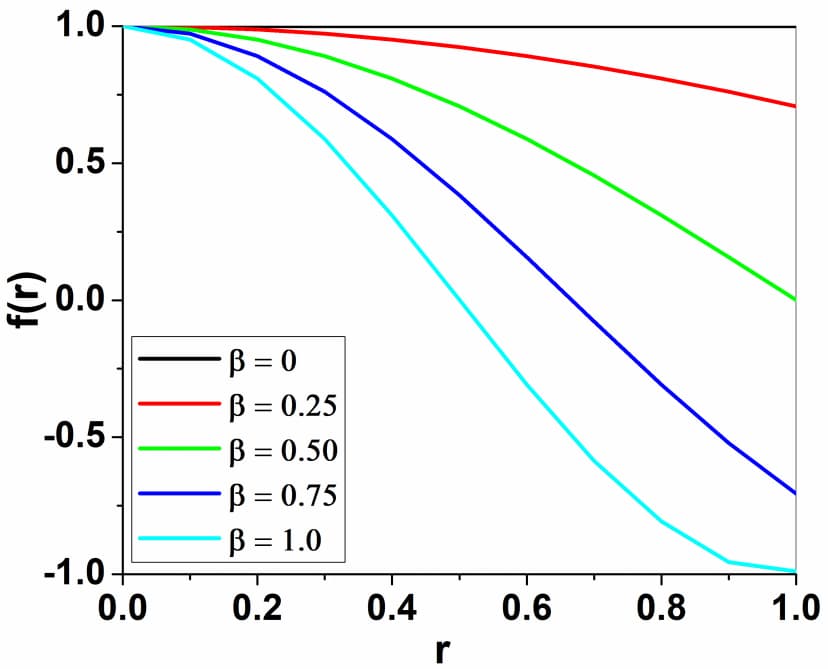
This study demonstrates that the Hanning amplitude filter can effectively achieve super resolution in aberrated optical systems without requiring complex hardware or iterative algorithms. By tuning a single apodisation parameter, the filter reduces the first dark ring radius by nearly 36 percent compared to the classical Airy case, while also suppressing side lobes substantially. These findings offer a practical, low cost solution for enhancing resolution in microscopy, astronomy, and telecommunications where defocus and spherical aberration are unavoidable.
The intensity point spread function of a rotationally symmetric optical system apodised with a generalized Hanning amplitude filter was numerically analyzed under defocus and primary spherical aberration. As the apodisation parameter β increases, the central maximum intensity first decreases to 0.0062 at β = 0.7 and then recovers to 0.1647 at β = 1.0. The first dark ring radius shrinks from 3.8317 to 2.4560, a reduction of 35.9 percent, demonstrating clear super resolution. Side lobes are completely eliminated at β = 0.5.
Article type: Research Article
Submitted: 13 October 2025
Revised: 22 November 2025
Accepted: 7 December 2025
First published: 27 December 2025
DOI: https://doi.org/10.69626/sea.2025.0177
Volume: 2
Issue: 4
Pages: 177-185
Citation: SciEngg Advances 2(4), 177-185 (2025)
Sambaiah, B., Kiranmai, N. S. and Sagar, D. K. 2025. Shaping the Point Spread Function in Aberrated Optical Systems Using Hanning Amplitude Filters for Super-resolution Imaging. SciEngg Advances 2(4), pp. 177-185; https://doi.org/10.69626/sea.2025.0177.
Number of downloads: 2
Number of views: 54