


Subscribe To Get Information, Latest News And Other Interesting Events!



Important Links
Get In Touch
Ariston Publication
3167 Riverview Place
Columbus, OH 43202
United States of America
Copyright © 2026 Ariston Publications. All Rights Reserved.
Loading Your Library
Preparing your reading experience...
Loading content...
Ariston Publication
3167 Riverview Place
Columbus, OH 43202
United States of America
Kamlesh Kumar, M. Imran Aziz
1 Physics Department, Government Degree College, Madhuban, Mau-221603, Uttar Pradesh, India
2 Physics Department, Shibli National Postgraduate College, M. S. D. University, Azamgarh-276001, Uttar Pradesh, India
* Author to whom correspondence should be addressed:
kamleshku79@gmail.com (Kamlesh Kumar)
This study investigates the structural and electronic properties of monolayer stanene, a two-dimensional honeycomb material composed of tin atoms. The calculations were performed within the framework of density functional theory as implemented in the Quantum ESPRESSO package. We systematically examined the total energy convergence, lattice constant relaxation, and k-point sampling to ensure reliable predictions. The optimized geometry reveals a low-buckled honeycomb structure rather than a perfectly planar one, which is found to be energetically more stable. The calculated lattice constant, bond length, and buckling height are in good agreement with previously reported theoretical and experimental values. The electronic band structure without spin-orbit coupling shows linear dispersion near the high symmetry K and K′ points, similar to graphene, indicating that charge carriers behave as massless Dirac fermions. In this case, stanene exhibits a gapless semimetallic character. However, when spin-orbit coupling is included, a direct band gap opens at the Dirac point, transforming stanene into a topological insulator with potential for dissipationless electronic transport. The total and partial density of states further confirm the semimetallic nature and highlight the dominant contribution of pz orbitals near the Fermi level. The mixed sp²–sp³ hybridization due to buckling is responsible for the deviation from ideal planar symmetry. Our computed results align well with existing literature, validating the accuracy of our computational approach. Overall, this work provides a clear understanding of how structural buckling and spin-orbit coupling together govern the electronic behavior of stanene, making it a promising candidate for future nanoelectronic and spintronic devices.
The work demonstrates how structural buckling and strong spin–orbit coupling collectively govern stanene’s electronic behavior. The gap opening enables dissipationless transport, positioning stanene as a promising room-temperature topological insulator for future nanoelectronic and spintronic devices. By clarifying how buckling and spin–orbit coupling together open a band gap, this study establishes stanene as a room-temperature topological insulator. The gap enables dissipationless transport, making stanene promising for low-power nanoelectronics and spintronic devices. The work provides a validated computational framework for future two-dimensional material design.
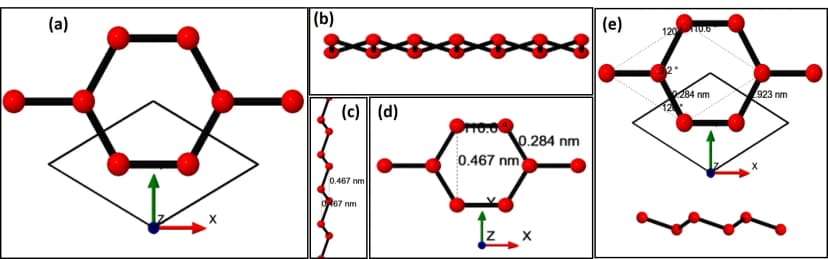
This study uses density functional theory to investigate monolayer stanene’s structural and electronic properties. Optimized geometry reveals a low-buckled honeycomb structure. Without spin–orbit coupling, stanene shows gapless semimetallic behavior with Dirac cones. Including spin–orbit coupling opens a direct band gap at the Dirac point, transforming stanene into a topological insulator. Using density functional theory, this work optimizes monolayer stanene’s buckled honeycomb structure, finding a lattice constant of 4.67 Å and buckling height of 0.85 Å. Without spin–orbit coupling, stanene exhibits gapless Dirac cones and semimetallic behavior.
Article type: Research Article
Submitted: 22 October 2025
Revised: 28 November 2025
Accepted: 14 December 2025
First published: 29 December 2025
DOI: https://doi.org/10.69626/sea.2025.0186
Volume: 2
Issue: 4
Pages: 186-194
Citation: SciEngg Advances 2(4), 186-194 (2025)