


Subscribe To Get Information, Latest News And Other Interesting Events!



Important Links
Get In Touch
Ariston Publication
3167 Riverview Place
Columbus, OH 43202
United States of America
Copyright © 2026 Ariston Publications. All Rights Reserved.
Loading Your Library
Preparing your reading experience...
Loading content...
Ariston Publication
3167 Riverview Place
Columbus, OH 43202
United States of America
Priyanka Yadav, Brijesh Kumar Pandey
Priyanka Yadav
Brijesh Kumar Pandey*
Nanofluid Laboratory, Department of Physics and Material Science, Madan Mohan Malaviya University of Technology, Gorakhpur- 273010, UP, India.
*Author to whom correspondence should be addressed:
bkpmmmec11@gmail.com(Brijesh Kumar Pandey)
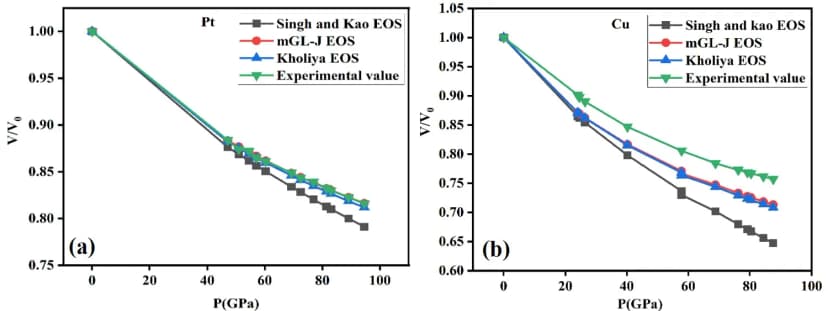
This work develops a mathematical framework to describe how metals compress in volume when exposed to high pressure. We systematically compared three thermodynamic equations of state, those proposed by Singh and Kao, the modified generalized Lennard-Jones (mGL-J) model, and the Kholiya equation, to evaluate their effectiveness in predicting volume compression. Each equation defines the interrelation among applied pressure, bulk modulus, volume compression ratio, and the first-order pressure derivative of the bulk modulus at ambient conditions. Using these models, we calculated the compression behavior of six common metals, aluminum, gold, copper, platinum, molybdenum, and tantalum, up to an external pressure of 30 GPa. Our calculations show that the mGL-J equation of state produces a notably steeper decline in the volume compression curve, which corresponds to a substantial rise in the bulk modulus with increasing pressure. When compared against existing experimental data, the mGL-J model consistently delivered the most accurate predictions across all tested metals. The Singh and Kao equation also performed reasonably well, showing good agreement with experimental results, though slightly less precise than the mGL-J model. The Kholiya equation followed similar trends but with minor deviations at higher pressures. Overall, this comparative study clarifies how different pressure regimes affect the volumetric response of metals. Such predictive models are especially valuable for engineering, materials science, and high-pressure physics, where direct experimental measurements remain challenging. Our findings confirm that selecting an appropriate equation of state is critical for reliable predictions of metal behavior under extreme conditions.
The findings provide clear guidance for selecting appropriate equations of state in high pressure materials research. The validated mGL-J model offers a reliable, computationally efficient tool for predicting metal behavior under extreme conditions where direct experiments are challenging. This has practical implications for geophysics, planetary science, aerospace engineering, and advanced manufacturing, where understanding material response to high pressure is essential for design and safety assessments. The comparative framework established here also serves as a benchmark for future model development.
This study systematically evaluated three equations of state, namely the Singh and Kao, the modified generalized Lennard-Jones, and the Kholiya models, for predicting volume compression in aluminum, gold, copper, platinum, molybdenum, and tantalum under pressures up to 30 GPa. Theoretical calculations were compared against experimental data to assess model accuracy. The mGL-J equation consistently outperformed the other two models, showing excellent agreement with measurements across all metals, while the Singh and Kao model performed reasonably well and the Kholiya model showed larger deviations at higher pressures.
Article type: Research Article
Submitted: 8 December 2025
Revised: 3 February 2026
Accepted: 5 March 2026
First published: 12 March 2026
DOI: https://doi.org/10.69626/sea.2026.0038
Volume: 3
Issue: 1
Pages: 38-46
Citation: SciEngg Advances 3(1), 38-46 (2026)