


Subscribe To Get Information, Latest News And Other Interesting Events!


Important Links
Get In Touch
Ariston Publication
3167 Riverview Place
Columbus, OH 43202
United States of America
Copyright © 2026 Ariston Publications. All Rights Reserved.
Loading Your Library
Preparing your reading experience...
Loading content...
Ariston Publication
3167 Riverview Place
Columbus, OH 43202
United States of America
Saurav Mishra, Brijesh Kumar Pandey Singh, Pradutt Kumar Bharti
| Saurav
Mishra Brijesh Kumar Pandey Singh* Pradutt Kumar Bharti |
Nanofluid
Laboratory, Department of Physics and Material
Science, Madan Mohan Malaviya University of Technology,
Gorakhpur 273010, Uttar Pradesh, India
*Author to whom correspondence should be addressed:
bkpmmmec11@gmail.com (B. Pandey)
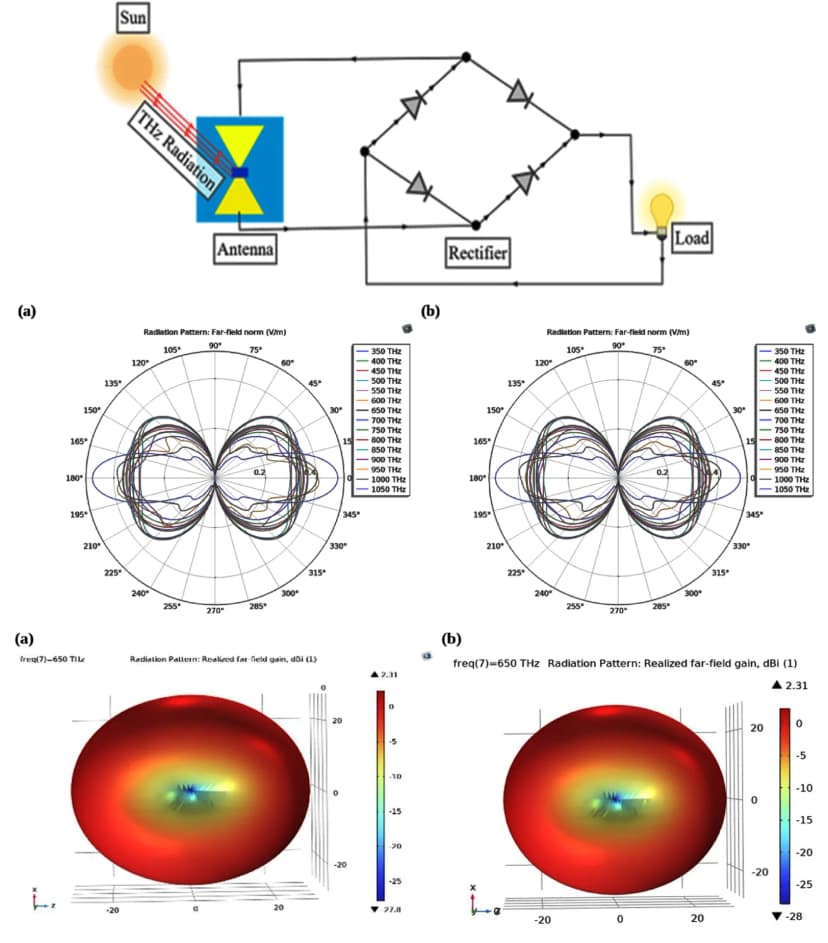
Optical rectennas-nanoantennas coupled to ultrafast rectifiers-offer a bandgap-free route to converting solar radiation into direct-current (DC) power, but their realisation requires antennas that combine broadband impedance matching with strong field confinement at the rectifier location. In this work, a silver bowtie nanoantenna (arm length 150 nm, flare angle 90°) on a 10 nm SiO2 layer is designed and analysed by full-wave finite-element simulation (COMSOL Multiphysics 6.2, RF Module) across the visible-near-infrared band (350-1050 THz; free-space wavelength 857-286 nm). Two feed-gap widths (20 and 30 nm) are compared in terms of reflection coefficient, input impedance, near-field distribution, radiation pattern and realised gain. Both designs resonate at ≈650 THz (≈461 nm) with a minimum S11 of −24.2 dB (20 nm) and −24.6 dB (30 nm). The −10 dB impedance bandwidth extends from ≈480 to ≈875 THz (≈390 THz, ≈57% fractional bandwidth). The maximum realised gain rises from ≈0.2 dBi at 350 THz to 3.25-3.28 dBi at 750 THz, and a dipole-like radiation pattern is maintained up to ≈850 THz, above which higher-order modes distort the pattern. Below 850 THz, changing the gap from 20 to 30 nm alters the minimum S11 by less than 0.5 dB and the gain by less than 0.05 dB, indicating tolerance to the gap variations typical of electron-beam lithography, whereas the peak gap field increases by ≈50% for the narrower gap. The strongest near fields occur at the feed gap, identifying it as the natural site for a metal-insulator-metal tunnelling diode. The remaining obstacles to a complete rectenna-rectifier cut-off frequency, antenna-diode impedance matching, polarisation and the partial coherence of sunlight-are discussed.
This study is significant because it provides a rigorous electromagnetic assessment of a silver bowtie nanoantenna as a candidate optical rectenna element for broadband solar-to-DC conversion, showing that a simple planar geometry can simultaneously support strong feed-gap field enhancement and wideband impedance behavior across the visible–near-infrared spectrum. Its novelty lies in the comparative analysis of two nanoscale gap widths under identical conditions, demonstrating that the antenna response remains largely robust to fabrication-relevant gap variations while the narrower gap produces substantially stronger localized fields for rectifier coupling. Scientifically, the work clarifies the resonance behavior, impedance bandwidth, radiation characteristics, and gain evolution of the structure, thereby identifying the feed gap as the most suitable location for an integrated tunnelling diode and highlighting the practical limits imposed by higher-order modes at shorter wavelengths. The key contribution is the establishment of a design window in which broadband matching and near-field concentration coexist, offering a basis for future optimization of antenna–rectifier integration. Potential applications include optical rectennas for direct photovoltaic conversion, nanoscale energy harvesting, and compact infrared-to-visible photonic devices, while the discussion of remaining challenges provides guidance for advancing toward fully functional rectenna systems.
A silver bowtie nanoantenna with a 150 nm arm length and 90° flare angle was designed on a 10 nm SiO2 substrate and analyzed in COMSOL across 350–1050 THz for optical rectenna applications. Two feed gaps, 20 nm and 30 nm, were compared for reflection coefficient, input impedance, near-field enhancement, radiation pattern, and realised gain. Both structures resonated near 650 THz with very low reflection (S11 ≈ −24 dB) and showed a broad −10 dB bandwidth from about 480 to 875 THz. The antenna gain increased from roughly 0.2 dBi at 350 THz to about 3.3 dBi at 750 THz, while maintaining a dipole-like pattern up to around 850 THz. Gap variation had little effect on impedance match and gain, but the smaller gap produced about 50% stronger field concentration, making the feed gap the preferred location for a tunnelling diode. The study concludes that the design offers broadband, field-enhanced performance suitable for rectenna use, while noting remaining challenges in rectifier cutoff frequency, impedance matching, polarization, and sunlight coherence.
Article type: Research Article
Submitted: 5 March 2026
Revised: 14 April 2026
Accepted: 5 May 2026
First published: 21 May 2026
DOI: https://doi.org/10.69626/sop.2026.0006
Volume: 01
Issue: 01
Pages: 06-18
Citation: Science of Optics and Photonics 1(1), 06-18 (2026)
Saurav Mishra, Brijesh Kumar Pandey Singh, Pradutt Kumar Bharti et al. 2026. Visible-Near-Infrared (350 - 1050 THz) Silver Bowtie Nanoantenna for Optical Rectenna Energy Harvesting : Dependent Full - Wave Study. Science of Optics and Photonics 1(1), pp. 06-18; https://doi.org/10.69626/sop.2026.0006
Number of downloads: 1
Number of views: 5