


Subscribe To Get Information, Latest News And Other Interesting Events!


Important Links
Get In Touch
Ariston Publication
3167 Riverview Place
Columbus, OH 43202
United States of America
Copyright © 2026 Ariston Publications. All Rights Reserved.
Loading Your Library
Preparing your reading experience...
Loading content...
Ariston Publication
3167 Riverview Place
Columbus, OH 43202
United States of America
Arun Uniyal, Vipin Sharma, Priyanka Dobhal Uniyal, D.K. Dwivedi
Arun
Uniyal1*
Vipin Sharma2
Priyanka Dobhal Uniyal3
D.K. Dwivedi4
1 Department of Electronics Communication Engineering,
Institute of Technology Gopeshwar, Chamoli, Uttarakhand
246424, India
2 Department of Physics, Rana Pratap Post Graduate College,
Sultanpur, Uttar Pradesh 228001, India
3 District Project Office, Samagra Shiksha, Chamoli,
Uttarakhand 246401, India
4 Department of Physics and Material Science, Madan Mohan
Malaviya University of Technology, Gorakhpur, 273010,
India
*Author to whom correspondence should be addressed:
arunavenue@gmail.com
(A. Uniyal)
Lossy Mode Resonance (LMR) has become an attractive approach for optical sensing due to its high sensitivity toward changes in the refractive index of various dielectric, semiconductor, or transparent conductive oxide (TCO) materials. A novel type of prism-coupled multi-layer lossy mode resonance sensor (Prism / Cytop / ITO / TiO2 / Sensing Medium) is designed and simulated by use of Transfer Matrix Method (TMM), which was written in MATLAB under angular interrogation. Indium Tin Oxide (ITO) is used as the lossy mode resonance support layer, while cytop and TiO2 layers were added to improve optical coupling, modal confinement and resonance performance. The effects of TM and TE polarizations, cytop thickness, ITO thickness and TiO2 thickness on reflectance spectra are examined thoroughly. The sensor was tested for refractive index values ranging from 1.33 – 1.41 at a wavelength of 633 nm. It can be seen that the TE polarization mode shows a narrower resonant peak with smaller minima in reflection spectrum and better detection accuracy than TM polarization mode. The optimization of multi-layered structure show that a 5nm thick TiO2 layer offers the strongest and most defined LMR effect and therefore chosen as the best configuration.
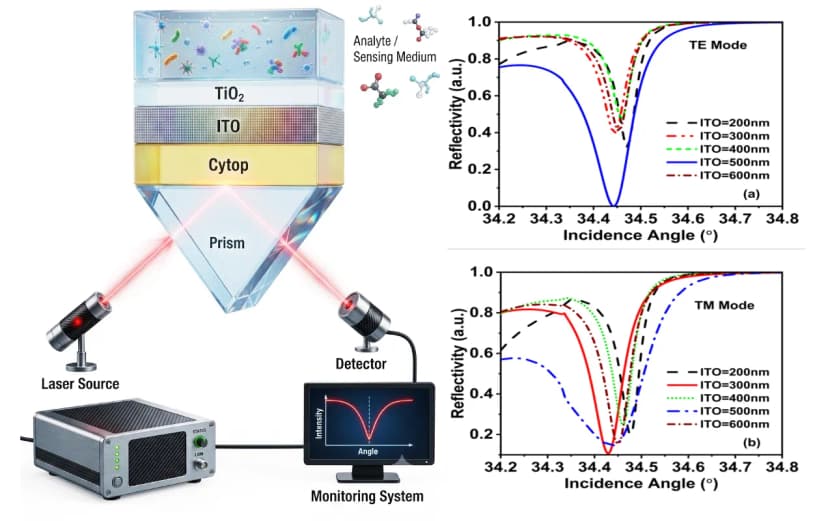
This work is significant because it demonstrates, through Transfer Matrix Method simulation, a prism-coupled multilayer LMR sensor architecture that enhances optical coupling and resonance behavior by integrating Cytop, ITO, and TiO2 layers. Its novelty lies in the systematic assessment of a Prism/Cytop/ITO/TiO2/sensing-medium configuration under angular interrogation, including a detailed comparison of TM and TE polarizations and the optimization of individual layer thicknesses. Scientifically, the study clarifies how Cytop and TiO2 influence modal confinement and resonance performance, and it identifies TE polarization as providing a narrower resonance peak, lower reflectance minimum, and improved detection accuracy relative to TM polarization. The results also establish that a 5 nm TiO2 layer yields the strongest and most distinct LMR response, providing a practical design guideline for future sensor optimization. Potential applications include refractive index sensing in chemical, biological, and environmental monitoring systems where high sensitivity and precise optical readout are required.
This study presents a prism-coupled multilayer lossy mode resonance (LMR) refractive index sensor based on the structure Prism/Cytop/ITO/TiO2/Sensing Medium. The sensor was modeled using the transfer matrix method in MATLAB under angular interrogation at 633 nm. ITO served as the LMR-supporting layer, while Cytop and TiO2 were introduced to enhance optical coupling, mode confinement, and resonance quality. The influence of TM and TE polarizations, as well as Cytop, ITO, and TiO2 thicknesses, was analyzed for sensing media with refractive indices from 1.33 to 1.41. Results showed that the TE mode produced sharper resonance dips, lower reflectance minima, and better sensing performance than TM mode. Optimization of the multilayer design indicated that a 5 nm TiO2 layer provided the strongest and clearest LMR response, making it the most suitable configuration for improved sensor performance.
Article type: Research Article
Submitted: 10 March 2026
Revised: 20 April 2026
Accepted: 10 May 2026
First published: 23 May 2026
DOI: https://doi.org/10.69626/sop.2026.0019
Volume: 01
Issue: 01
Pages: 19-28
Citation: Science of Optics and Photonics 1(1), 19-28 (2026)
Arun Uniyal, Vipin Sharma, Priyanka Dobhal Uniyal, D.K. Dwivedi et al. 2026. MATLAB Simulation based Study of a Lossy Mode Resonance Sensor Design with Improved Detection Accuracy. *Science of Optics and Photonics* 1(1), pp. 19-28; https://doi.org/10.69626/sop.2026.0019
Number of downloads: 0
Number of views: 3