


Subscribe To Get Information, Latest News And Other Interesting Events!


Important Links
Get In Touch
Ariston Publication
3167 Riverview Place
Columbus, OH 43202
United States of America
Copyright © 2026 Ariston Publications. All Rights Reserved.
Loading Your Library
Preparing your reading experience...
Loading content...
Ariston Publication
3167 Riverview Place
Columbus, OH 43202
United States of America
Shatrughan Mishra, Pooja Lohia, D.K. Dwivedi, Akash Anand Verma
Shatrughan Mishra1
Pooja Lohia1*
D.K. Dwivedi2
Akash Anand Verma3
1 Department of Electronics and Communication Engineering Madan Mohan Malaviya University of Technology, Gorakhpur-273010, U.P, India
2 Photonics and Photovoltaic Research Lab (PPRL) Department of Physics and Material Science Madan Mohan Malaviya University of Technology, Gorakhpur- 273010, India
3 Department of Physics Udit Narayan Post Graduate College, Padrauna, Kushinagar-274304, U.P, India
*Author to whom correspondence should be addressed:
lohia.pooja6@gmail.com (P. Lohia)
Focusing on the next generation of lead-free photovoltaics, this study presents a comprehensive comparison of CH3NH3SnI3-based tin perovskite solar cells (PSCs), emphasizing the influence of various hole-transporting layers (HTLs) on their performance and operational stability. A comparative assessment of organic and inorganic HTLs using SCAPS-1D simulations, focusing on their effects on performance and spectral response has been investigated. Notably, TAPC (1,1-Bis[(di-4-alkylamino)phenyl]cyclohexane) emerged as a superior HTL candidate, enabling an outstanding efficiency of 31.82% at bulk material thickness of 0.3 μm, with an open circuit voltage(Voc) = 1.19 V, Short circuit current density(JSC) 32.20 mA/cm2, fill factor(FF) 82.73 and delivering quantum efficiency about 90% across the wavelength range 400–800 nm range due to the efficient optical absorption and minimal recombination losses, effectively capturing the full visible light spectrum. These results represent an important step forward for tin-based perovskite systems, as they show TAPC’s possibility of establishing the performance gap between lead-based and eco-friendly solar cells.
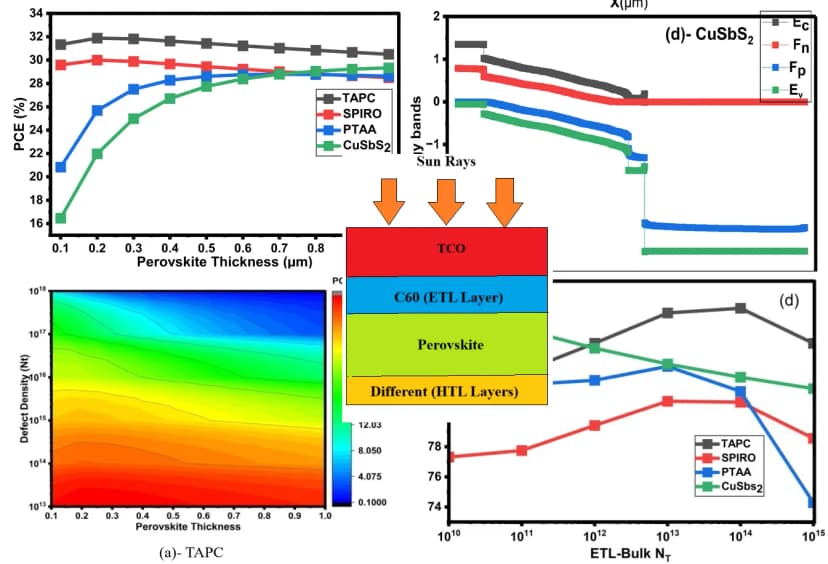
This study is significant because it provides a systematic SCAPS-1D comparison of organic and inorganic hole-transporting layers for CH3NH3SnI3-based lead-free perovskite solar cells, addressing a key challenge in developing environmentally safer photovoltaic technologies with competitive performance. Its novelty lies in identifying TAPC as a particularly effective HTL for tin perovskite devices and quantitatively demonstrating its impact on device efficiency, photovoltage, current density, fill factor, and spectral response. Scientifically, the work clarifies how HTL selection influences carrier extraction, recombination losses, and overall optoelectronic behavior, thereby offering design guidance for optimizing lead-free perovskite architectures. The main contribution is the prediction of a high-efficiency device performance with broad quantum efficiency across the visible spectrum, supporting the potential of tin-based PSCs as viable candidates for next-generation solar energy conversion. These findings may inform future experimental development of stable, high-performance, and more sustainable photovoltaic devices for renewable energy applications.
The study evaluates CH3NH3SnI3-based lead-free tin perovskite solar cells using SCAPS-1D to compare different organic and inorganic hole transport layers (HTLs) in terms of efficiency, spectral response, and operational stability. Among the HTLs examined, TAPC performed best, delivering a simulated power conversion efficiency of 31.82% at a 0.3 μm absorber thickness, with Voc of 1.19 V, Jsc of 32.20 mA/cm², and FF of 82.73%. It also achieved about 90% quantum efficiency across 400–800 nm, attributed to strong optical absorption and reduced recombination losses. The work highlights TAPC as a promising HTL for improving the performance of eco-friendly tin-based perovskite solar cells and narrowing the gap with lead-based devices.
Article type: Research Article
Submitted: 15 March 2026
Revised: 25 April 2026
Accepted: 18 May 2026
First published: 26 May 2026
DOI: https://doi.org/10.69626/sop.2026.0029
Volume: 01
Issue: 01
Pages: 29-43
Citation: Science of Optics and Photonics 1(1), 29-43 (2026)
Mishra, S., Lohia, P., Dwivedi, D.K. and Verma, A.A. 2026. Unlocking the Potential of Tin − Based Perovskite Solar Cells through Hole Transport Layer Engineering. Science of Optics and Photonics 1(1), pp. 29-43; https://doi.org/10.69626/sop.2026.0029.
Number of downloads: 0
Number of views: 2