


Subscribe To Get Information, Latest News And Other Interesting Events!


Important Links
Get In Touch
Ariston Publication
3167 Riverview Place
Columbus, OH 43202
United States of America
Copyright © 2026 Ariston Publications. All Rights Reserved.
Loading Your Library
Preparing your reading experience...
Loading content...
Ariston Publication
3167 Riverview Place
Columbus, OH 43202
United States of America
Gaurav Dixit,, Lalit K. Dwivedi, Vipin Sharma, Arun Uniyal, Sachin Singh, Sunil P. Singh, Sandeep Kumar Nigam
Gaurav Dixit1,2
Lalit K. Dwivedi1
Vipin Sharma3
Arun Uniyal4*
Sachin Singh5
Sunil P. Singh1
Sandeep Kumar Nigam6
1 Department of Physics Electronics, Kamla Nehru Institute of Physical and Social Sciences, Sultanpur-228118 (U.P.), India
2 Department of Physics, RMP Post Graduate College, Sitapur-261001 (U.P.), India
3 Department of Physics, Rana Pratap Post Graduate College, Sultanpur-228001 (U.P.), India
4 Department of Electronics and Communication Engineering, Govt. Institute of Technology Gopeshwar-246424 Uttarakhand, India
5 Faculty of Physical Sciences, Shri Ramswaroop Memorial University, Lucknow, Deva Road, Barabanki-225003 (UP), India
6 Department of Physics Government Post Graduate College, Mushafirkhana, Amethi (U.P.), India
*Author to whom correspondence should be addressed:
arunavenue@gmail.com (A. Uniyal)
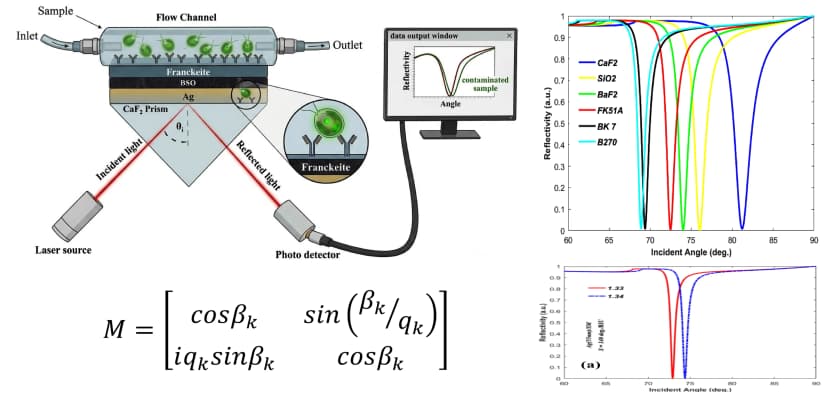
In this study, a high-performance, label-free surface plasmon resonance (SPR) biosensor based on a Kretschmann configuration is proposed and numerically evaluated at an operating wavelength of 633 nm. The sensing architecture comprises a low-index calcium fluoride (CaF2) coupling prism, a 55 nm silver (Ag) thin film, a 9 nm bismuth silicate (Bi12SiO20,BSO) dielectric intermediate layer, and a 0.5 nm two-dimensional (2D) Franckeite overlay. The integration of the BSO/Franckeite bilayer strategically confines the evanescent electromagnetic field at the sensing boundary while passivating the underlying silver layer against oxidation. Using the Transfer Matrix Method (TMM) to simulate angular interrogation across analyte refractive indices ranging from 1.33 to 1.34, the structural parameters were systematically optimized. Comparative analysis demonstrates that the optimized CaF2/Ag/BSO/Franckeite heterostructure achieves a maximum angular sensitivity of 311o/RIU, an improvement over the conventional CaF2/Ag baseline (140o/RIU ), alongside a detection accuracy of 0.42 deg−1, a full width at half maximum of 2.34o, and a figure of merit/quality factor of 141.36 RIU−1. These results highlight the synergistic potential of 2D material-enhanced plasmonic heterostructures and provide design guidelines for sensitive biochemical sensing.
This work is significant because it demonstrates, through numerical optimization, that integrating a Bi12SiO20, (BSO) interlayer and an ultrathin Franckeite overlay into a conventional CaF2/Ag Kretschmann SPR platform can substantially improve label-free sensing performance at 633 nm while also providing oxidation protection for the silver film. Its novelty lies in the specific use of the BSO/Franckeite bilayer to enhance electromagnetic field confinement at the sensing interface and to synergistically tune the resonance response, resulting in a marked increase in angular sensitivity relative to the bare CaF2/Ag structure. The study’s key contribution is a systematic Transfer Matrix Method-based design framework that identifies an optimized heterostructure with high sensitivity, improved detection accuracy, a narrow resonance linewidth, and a strong figure of merit, thereby establishing a clear performance benchmark for 2D material-assisted plasmonic biosensors. Scientifically, the results strengthen understanding of how dielectric/2D-material hybrid coatings can modulate plasmonic coupling and improve sensor functionality. Potential applications include high-resolution biochemical and refractive-index sensing in environmental monitoring, biomedical diagnostics, and lab-on-chip analytical platforms.
The study proposes and numerically analyzes a label-free SPR biosensor in a Kretschmann configuration operating at 633 nm. The structure uses a CaF2 prism, 55 nm Ag film, 9 nm BSO layer, and 0.5 nm Franckeite overlayer. The BSO/Franckeite bilayer enhances field confinement at the sensing interface and protects silver from oxidation. Using TMM and angular interrogation for refractive indices from 1.33 to 1.34, the design was optimized. The optimized sensor achieved a sensitivity of 311°/RIU, compared with 140°/RIU for the bare CaF2/Ag system, along with 0.42 deg−1 detection accuracy, 2.34° FWHM, and a figure of merit of 141.36 RIU−1. The results show that 2D-material-assisted plasmonic heterostructures can significantly improve biosensing performance.
Article type: Research Article
Submitted: 29 May 2026
Revised: 23 August 2026
Accepted: 28 August 2026
First published: 29 August 2026
DOI: https://doi.org/10.69626/sop.2026.0071
Volume: 01
Issue: 01
Pages: 71-79
Citation: Science of Optics and Photonics 1(1), 71-79 (2026)
Dixit, G., Dwivedi, L.K., Sharma, V., Uniyal, A., Singh, S., Singh, S.P. and Nigam, S.K. 2026. Numerical Modeling and Performance Optimization of a Highly Sensitive Bismuth Silicate and Franckeite based Hybrid SPR Biosensor. Science of Optics and Photonics 1(1), pp. 71-79; https://doi.org/10.69626/sop.2026.0071.
Number of downloads: 0
Number of views: 2